
The Currency Drift
How the notion of quantum advantage drifted from complexity classes to Joules and dollars, and finally to Linkedin impressions

There is a quiet story to be told about how the currency of quantum advantage changed. The physics remained as it has been since 1925. What counts as winning morphed considerably, and the unit in which the score is kept has shifted twice in thirty-five years. With each shift the claim became easier to make. Read charitably, the first shift was forced by circumstance. The second shift is a marketing instrument and cannot be read charitably at all. It serves as an example of what happens when money taints science.
Complexity (1990)
In 1990 Itamar Pitowsky published a paper in Iyyun, the Jerusalem philosophical quarterly, titled “The Physical Church Thesis and Physical Computational Complexity.” The paper made an observation and asked a simple question. Quantum mechanics permits a kind of parallelism that classical physics does not. Identical particles squeezed together collapse, by the Pauli exclusion principle, into a symmetric subspace whose dimension grows polynomially while the full configuration space grows exponentially. The encoding is free. Nature does it automatically. So can a quantum system, by exploiting this compression, solve a classically hard problem in polynomial time?
Pitowsky’s answer, four years before Shor, was the deepest answer the field has produced. He took a specific NP-complete problem (ONE IN THREE 3-SATISFIABILITY) and translated it into the language of indistinguishable spin states. He constructed the quantum operator whose eigenvalues would, if measurable, reveal the answer. And then he asked the question that mattered: can you build the apparatus to measure this operator in polynomial time?
He suspected not. The construction of the measurement apparatus, he argued, might itself require solving the original problem.
Encoding was effortless. Retrieval was the whole problem. Quantum probability is non-Boolean, and that non-Boolean character permits probability distributions classical physics cannot reach. Pitowsky even demonstrated this geometrically. The only place a quantum advantage can be found is in the “space” that his correlations polytopes described. But reaching into this space requires constructing the right superposition for the right problem, and there is no general procedure for that. There are only specific shortcuts through specific terrain.
This is the currency of stage one. Advantage (a term not yet coined but implied by comparing complexity classes and using “shortcut”. Pitowsky later used “speedup”) means a complexity-class separation. The unit is computational steps or operations as a function of input size. The score is an asymptotic curve, not a number. Shor’s 1994 algorithm partially vindicated Pitowsky: factoring has the algebraic structure that lets you build the clever superposition, and Vazirani’s quantum Fourier transform is its irreplaceable physical ingredient. Grover’s 1996 algorithm gave a square-root speedup for unstructured search, and in 1997 Bennett, Bernstein, Brassard, and Vazirani proved it optimal. The square root of an exponential is still an exponential, so quantum machines do not solve NP-complete problems in polynomial time by brute-force search.
The terrain stayed sparse. Three classes of problems where the advantage was proven: factoring, unstructured search, quantum simulation, A fourth was added in April 2026 by the Google team’s quantum oracle sketching paper, an exponential space advantage with no time-speedup. In all four cases the currency is the same. Computational steps or operations versus input size. An asymptotic curve. Currency as a scaling claim.
The wall clock (2012, 2019)
In March 2012 John Preskill posted “Quantum computing and the entanglement frontier” to the arXiv. The paper proposed the term “quantum supremacy” for the moment a programmable quantum device performs a task no classical computer can match in any feasible time. Preskill was careful. He explicitly rejected “advantage” because he wanted the word to carry the weight of a complexity-class separation, complete classical intractability, not a slight edge. The 2012 formulation is still complexity-flavored. “Feasible” does the work that “polynomial” used to do, and the implicit translation between the two is what allowed the term to do its job.
Note, however, that the asymptotic curve disappeared. From in principle we moved to in practice. Perhaps, once it was clear that the current hardware won’t factor numbers bigger than 21 anytime soon, its future promises were getting hard to sell, and slide decks required lower hanging fruits that could still deliver the funding.
In October 2019 the Google Quantum AI team published the Sycamore paper in Nature. Sycamore had performed a random circuit sampling, a useless task by all means, in 200 seconds. Google estimated that the same task on Summit, then the world’s fastest classical supercomputer, would take 10,000 years. Two days before publication, IBM responded that with full disk storage and a better simulation algorithm, the task could be done in 2.5 days. By 2024 Google’s own estimate, on Frontier (the best supercomputer then) and against improved tensor network methods, was 6 seconds.
This is the inflection point. The unit changed from asymptotic computational steps to seconds. The score became a number, not a curve. The claim became 200 seconds versus 10,000 years, and five years later it became 200 seconds versus 6. An advantage that had been a complexity claim was now a footrace whose outcome depended on which classical algorithm you happened to be using on which day and on which hardware.
The shift was forced. NISQ machines have no fault tolerance, no proven scaling, no asymptotic regime to point to. They have one specific run on one specific day. The unit of measurement bent to fit the existing hardware.
The charitable reading of this shift is that the hardware existed so we might as well use it and see what it does. The uncharitable reading is that the hardware existed so we might as well find something to justify its R&D and manpower cost. Such a shift invited immediately de-quantization attempts. Be careful what you wish for, right? We have reviewed these (successful) attempts at length in a quintet that starts here. And when those came, things had to move again. Riverlane’s 2019 analysis of the Sycamore paper began doing the arithmetic that would become standard practice: Summit at residential electricity rates was about £2,500 to run the simulation, while Sycamore’s processor used 4.2 × 10⁻⁴ MWh. The new vocabulary was already being assembled.
Cost (2023, 2026)
Four years. That’s what it took for the second shift to become explicit. In August 2023 a paper appeared on the arXiv titled “Potential Energy Advantage of Quantum Economy”. The opening sentence does the work: “Deviating from the conventional notion of quantum advantage based solely on computational complexity, we redefine advantage in an energy efficiency context.” A Cournot competition model with energy as the budget constraint shows that quantum computing firms can outperform classical counterparts on profitability at Nash equilibrium. The argument is about market structure, not physics.
The cleanest statement of the new frame is the Quandela / ETH Zurich paper of January 2026, titled “Quantum Energetic Advantage before Computational Advantage in Boson Sampling.” The authors define quantum energetic advantage as a lower energy cost per sample compared to the best-known classical implementation, and they show that this advantage can emerge before computational advantage, in regimes where the classical algorithm is still faster. A quantum machine can be slower in seconds and ahead in joules.
The math works: on photonic platforms the energy figures favor the quantum side because most of the apparatus runs at room temperature. The intellectual move is to detach the word advantage from the question it used to answer. In 1990 the question was whether quantum physics could offer shortcuts to computational complexity. In 2026 the question, when you read past the noun, is whether the quantum apparatus consumes less electricity. These are different, of course. The first is about computation. The second is about a particular piece of hardware on a particular task, at a particular date, against a particular classical baseline.
The new currency is also looser than the old one. Energy per sample depends on the choice of classical machine, the choice of cooling architecture, the choice of error suppression overhead, and the choice of task. Each parameter is a place to put a thumb on the scale.

Which means that quantum advantage now depends on the price of a barrel of Brent crude, on whether the data center’s solar panels have silver or copper in them, and whether it is July in Arizona or February in Helsinki. Heck, quantum advantage now depends on whether the programmer who wrote the classical baseline is on minimum wage at an AWS contractor, or holds Series C options and bills himself out at four hundred dollars an hour.
The Q-CTRL case (May 2026)
When the unit of measurement is sensitive to weather, geopolitics, and Bay Area compensation packages, we get the following chain of events that spanned a single week of May 2026.
On May 5 Q-CTRL and IBM posted a careful engineering paper, Fast, accurate, high-resolution simulation of large-scale Fermi-Hubbard models on a digital quantum processor. 1D Fermi-Hubbard on the ibm_boston processor. Up to 120 qubits, up to 90 Trotter steps, up to 13,800 two-qubit gates. The application-aware compilation is real engineering. The classical baseline is ITensorMPS.jl running on a single AWS c7i.8xlarge instance: 32 vCPU, 64 GB RAM, no GPU. Past t ≈ 5.2 in inverse hopping units, the paper notes that “it is not possible to know which simulation methodology most accurately reflects the true system dynamics.” The paper acknowledges that GPU acceleration, algorithmic improvements, or narrow-purpose tooling could close the gap. The phrase quantum advantage does not appear attached to the result.
On May 6 the press release went out. EIN Presswire, “Q-CTRL Delivers 3,000x Speedup in Materials Discovery, Demonstrates Evidence of Practical Quantum Advantage.” Two minutes of quantum runtime, 100 hours of classical runtime, ratio 3000, claim elevated to practical quantum advantage. 1D Fermi-Hubbard, which Lieb and Wu solved in 1968 by Bethe ansatz and which every second-year many-body course teaches, is re-framed as materials discovery relevant to energy transmission, storage, and generation. A BCG quote upgrades it further to room-temperature superconductors and describes the achievement as “a major signal to industry that quantum simulation is both ready and an essential component of the R&D roadmap for future materials discovery”. Granted, the team did look at the far from equilibrium sector which is non-trivial and hard to simulate, but hard to simulate with what? They used a CPU as a benchmark. Why not a toaster oven?
On the same day Jay Gambetta of IBM Quantum posted to LinkedIn that Q-CTRL had reached a solution 3,000 times faster than state-of-the-art classical methods, and that the infrastructure would soon be available as a Qiskit Function so others could build on this work and bring quantum computing directly into chemistry and materials R&D.
Three documents, twenty-four hours apart, one runtime ratio. Paper: honest about the classical baseline. Press release: honest about the runtime ratio. Linkedin post: honest about the gate count and the product launch. Each is silent, however, about what the next one will use (presumably the cost of Qisqit software time slot?). The currency that began as a complexity claim, became a wall-clock ratio in 2019, was redefined as energy cost in 2023–2026, and arrives in May 2026 as an SKU with a barcode.
And Q-CTRL’s “practical advantage” result?
Ah, yes. A few days later it was reproduced by a competitor to an accuracy better than 0.01, in about five minutes on a MacBook Pro, using the same open-source library family the original benchmark itself had relied on.
For free.
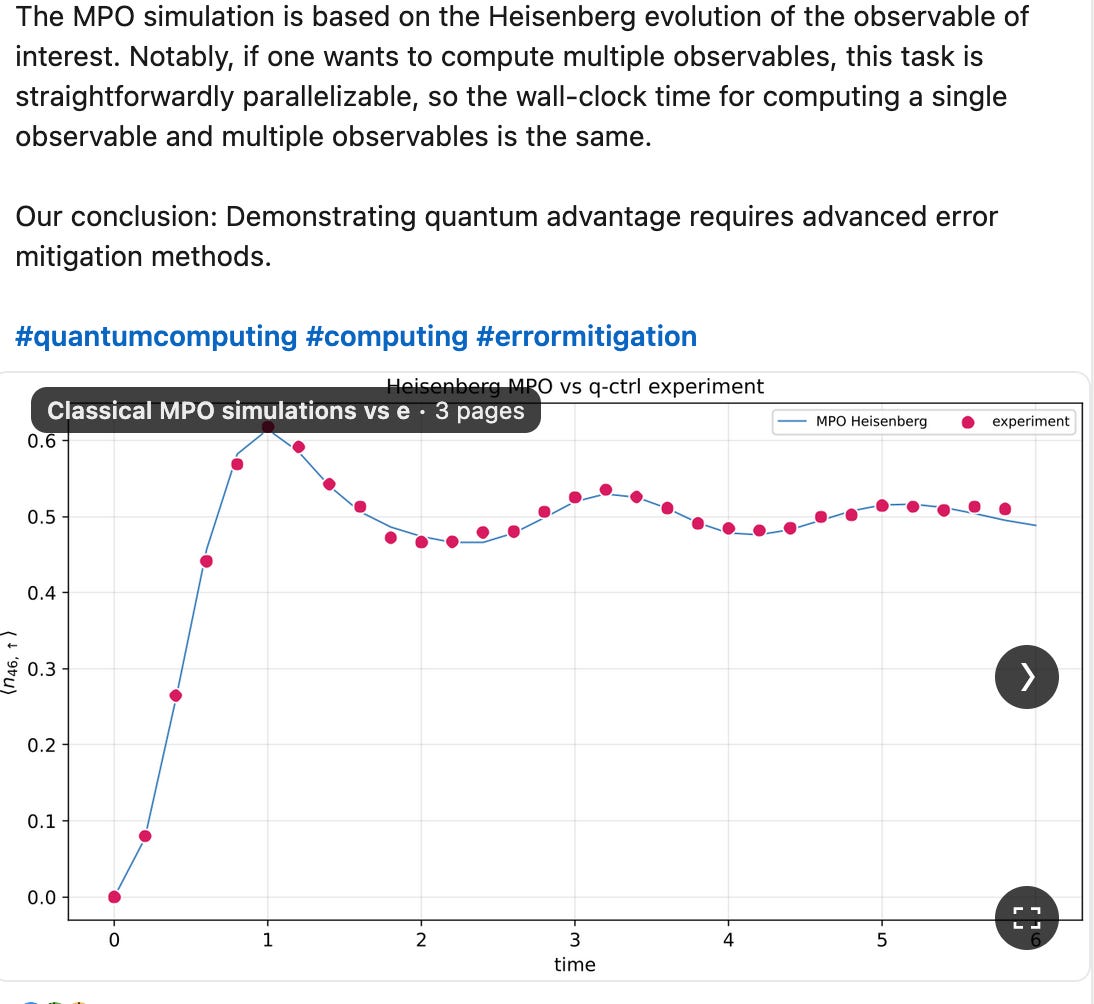
Q-CTRL grumbled and said that they only reproduced the low weight correlations (which was also the only thing Q-CTRL could demonstrate, so, there’s that).
But on June 3rd 2026, Multiverse Computing, another competitor, closed the gap by 83×, running the 1D simulation on a GPU for ~100 min. It also certified the unverified window Q-CTRL left open, for the entire low and high entanglement windows, extending it past the QPU. How’s that for practical?
Multiverse computing ended their paper with the devastating sentence: “These results substantially narrow the quantum–classical performance gap and establish a new standard for tensor-network benchmarking of large-scale quantum simulations.” Hear that Q-CTRL? You need to improve your standards.
But don’t you worry. Q-CTRL continues to present their result as “practical quantum advantage.”
Aymptotics was always for nerds anyway.