
Seven Years Ago Google’s Quantum Computer Solved a Useless Problem
The Longest Calculation: Quantum Computing, an Inside Story. Forthcoming Book. Episode IX

On October 23, 2019, Google published a paper in Nature announcing that its 53-qubit Sycamore processor had performed a computation in 200 seconds that would take the world’s fastest classical supercomputer approximately 10,000 years. The word they used was supremacy. The task was sampling the output distribution of a random quantum circuit, a computation specifically chosen because it is easy for a quantum computer and exponentially hard for a classical one. It had no practical application. That was the point. Supremacy required only that the computation be real and classically intractable. It required nothing useful.
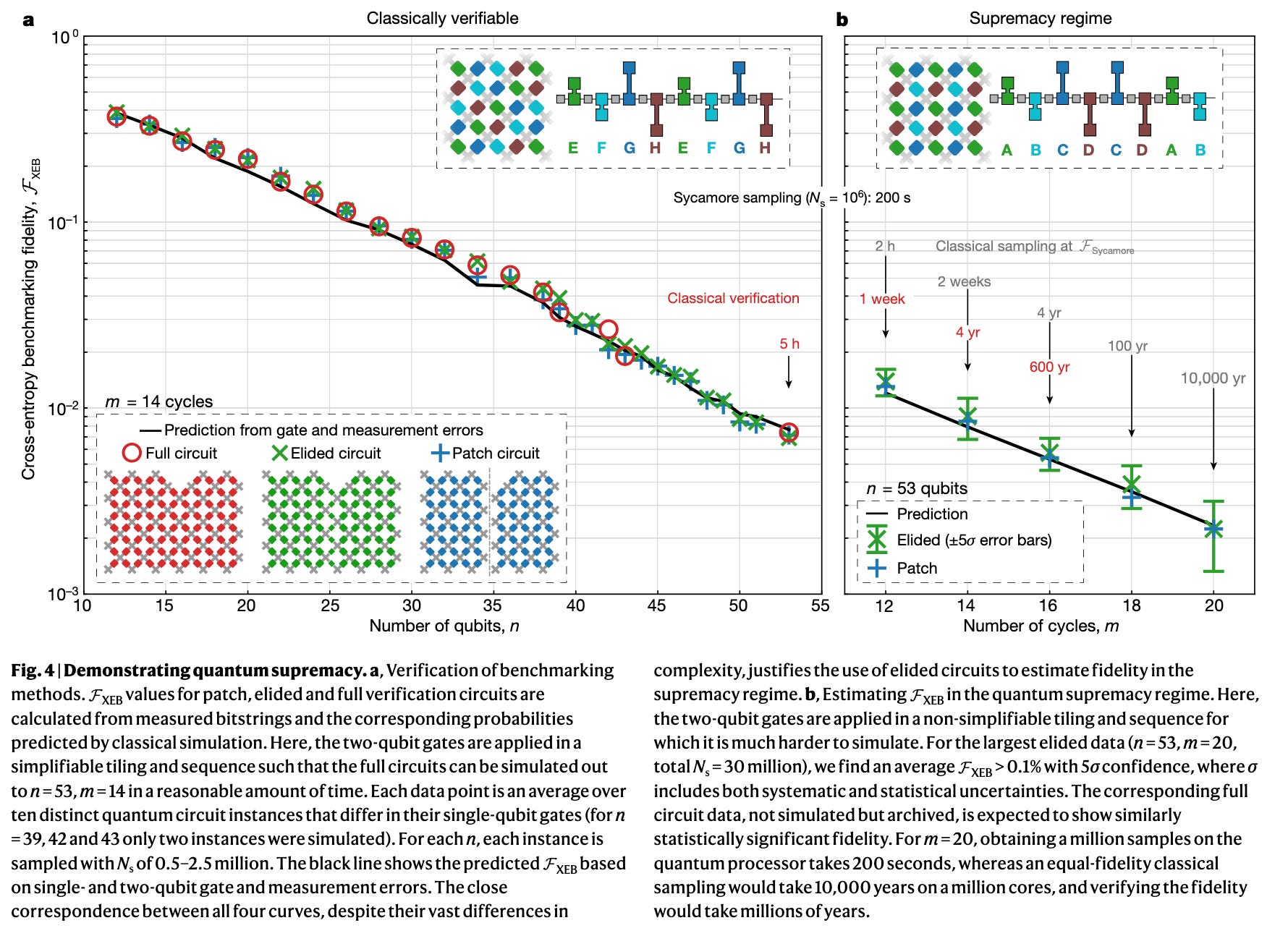
Two days before the Nature publication, IBM struck. Their quantum team argued that by using the full disk storage of the Summit supercomputer at Oak Ridge, the classical simulation could be completed in two and a half days. If IBM was right, the quantum computer was faster, but the classical one was feasible, and the definition of supremacy had not been met. The dispute was genuine. It also illuminated something important: the boundary between what a classical computer can and cannot do is a moving target. Classical algorithms improve. Hardware improves. A supremacy demonstration is a snapshot of a moving boundary taken at a single moment.
By 2024, the snapshot had expired. Improvements in classical tensor network algorithms meant that simulating 53 qubits with Sycamore-level fidelity would take approximately six seconds on the Frontier supercomputer at Oak Ridge. Google’s own team published the estimate. The original 10,000-year claim, measured against the state of classical computation five years later, had evaporated.
Google reached for the Wright brothers. Sycamore was Kitty Hawk, the twelve-second flight that proved heavier-than-air travel was possible. The airplane took decades to become practical technology, and the first flight was useless by any commercial measure. What mattered was the proof of principle. IBM argued that Google had demonstrated something closer to a successful engine test than an actual flight. The analogy frayed the way analogies do when billions of dollars are at stake.
John Preskill, who had coined the term “quantum supremacy” in 2012, wrote a measured assessment. He acknowledged the objections and the hype. He also observed that the result was real. Something had been demonstrated that had never been demonstrated before. He later reflected on the word itself, noting that it had exacerbated overhyped reporting and that its association with white supremacy evoked a repugnant political stance. IBM adopted the alternative term “quantum advantage.”
The word did political work beyond what Preskill intended. Supremacy sounds like dominance. It sounds like a finish line. The actual achievement was a proof of concept for a contrived task on a processor that could sustain coherence for microseconds. The engineers who built it solved problems that the theorists of the 1990s would have considered beyond reach, and the achievement was real. The machine that would make any of it matter, the machine that could break the encryption protecting your bank account, remains orders of magnitude away: millions of physical qubits, error rates far below anything yet achieved, and an architecture for real-time error correction that, as the previous two posts described, remains an open engineering problem. The road to it passes through territory that the next posts in this series will map.