
Fifty-one Quantum Scientists Just Admitted: The Longest Calculation Is Still Decades Away.
Or: What happens when the people building the damn thing are allowed to tell the truth.

Fifty-one quantum scientists, one 91-page position paper, a Pentagon contract, and a set of conclusions the field would not have put in writing five years ago. The paper is How to Build a Quantum Supercomputer: Scaling from Hundreds to Millions of Qubits, first posted to arXiv in November 2024 and revised again twice with V3 appearing this March. Masoud Mohseni, late of Google Quantum AI, now at Qolab, leads the author list. Robert McDermott of UW-Madison is there. So is Igor Markov. So are HPE, national labs, a small constellation of startups, and the Development Bank of Japan. DARPA paid for it, under the Quantum Benchmarking Initiative, which was founded to produce exactly this kind of honest stocktaking.
I finished the manuscript of The Longest Calculation in February. Its central argument rests on three theses — the Long Game, Honest Difficulty, and Capture — each defended at length across nine chapters, and each, at the time of writing, a minority position. This month I read the Mohseni paper. Its fifty-one authors, collectively, argue all three.
The Long Game. Figure 1 of the paper is a qubit-count-over-time chart. It plots the UCSB repetition-code experiment of 2014, the Google supremacy machine of 2019, and the Willow surface-code experiment of 2024. Then it draws a pale arrow climbing to a million qubits by 2030 — the industry expectation projected in the glow of the supremacy announcement. The actual trajectory sits roughly two orders of magnitude below it. The caption, which I will paraphrase because I keep quotations short, says the current pace pushes the million-qubit goal back by several decades, and that is the optimistic scenario in which none of the scaling problems the paper catalogs slow things down further.
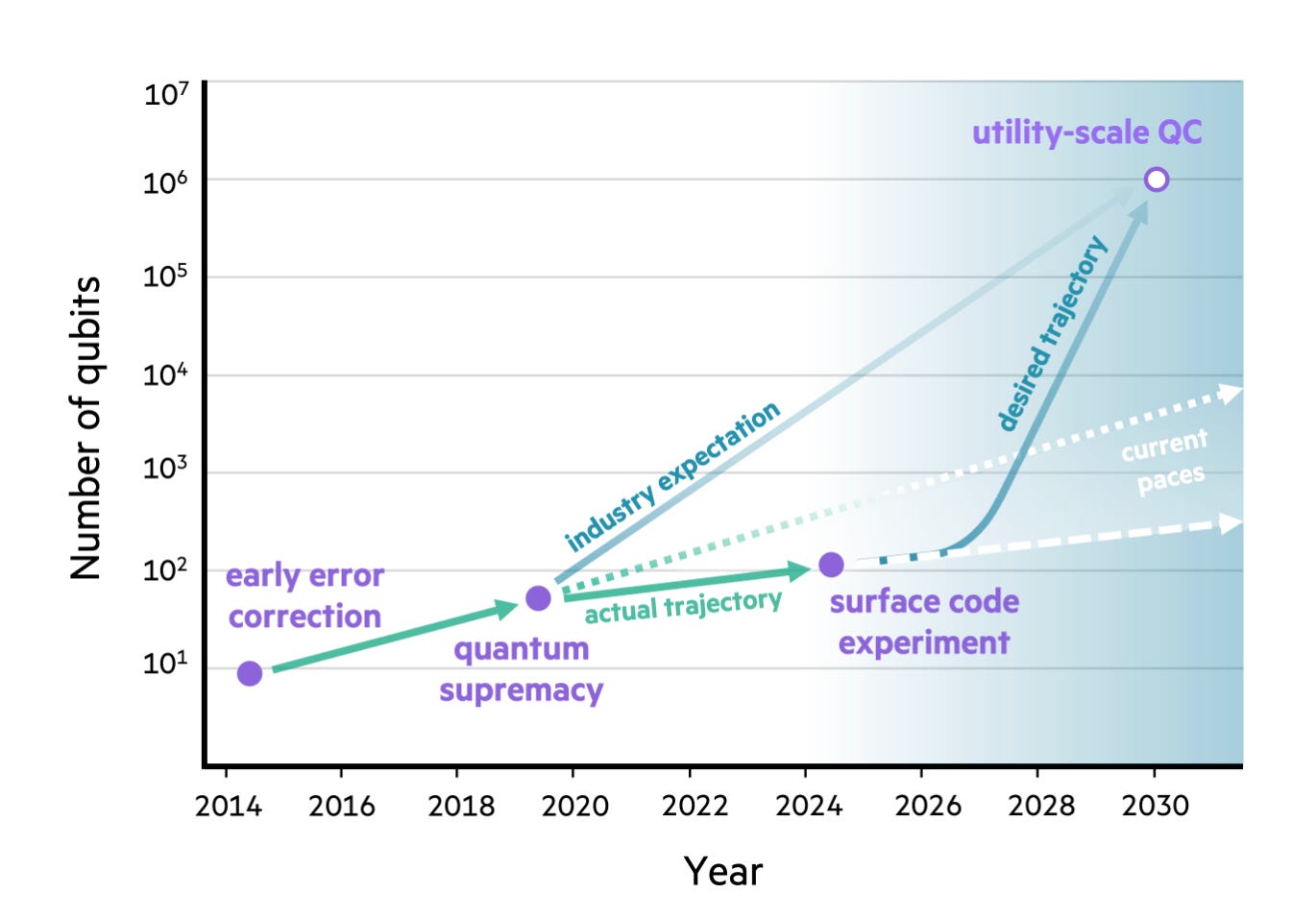
Several decades.
Written by a former Google technical lead. In a paper funded by the Pentagon.
Projecting real timelines has long been treated as defeatism in this field. Here is a figure, produced by the people who built the machines being plotted, showing the industry a generation behind schedule.
Honest Difficulty. The paper is a catalogue of the obstacles the field tends to leave out of keynote slides and press releases. A short inventory:
Fat-tailed error distributions. Coherence has two clocks. T1, the energy-relaxation time, is how long the qubit holds its state before decaying. T2, the dephasing time, is how long it holds the phase information on which quantum computation actually runs. T2 is bounded by 2·T1, so T1 is the ceiling on everything that matters. Coherence times are usually reported as the best or the median of T1. Mohseni and colleagues look at the tails. For published Google and IBM data, the worst ten percent of T1 values drops 30 to 100 times below a Gaussian fit. And because two-qubit gate errors correlate directly with T1 dropouts, the ragged floor propagates upward into every fidelity above it. In a machine of a hundred qubits, this is a curiosity. In a machine of a thousand, it is a verdict.
Re-calibration drift. Two-level-system defects in amorphous dielectrics fluctuate due to tunneling, and quantum processors must be re-calibrated to follow them. A hundred-qubit machine today needs full re-calibration roughly once a day, a process that takes up to two hours. The paper states plainly that a thousand-qubit machine becomes, by the same mechanism, effectively unusable — the re-calibration never catches up.
Cosmic rays. High-energy particles strike the chip and cause correlated error bursts that poison error correction wholesale. Clever engineering can push the logical error rate floor down toward ten to the minus ten, and no lower.
Decoder latency. The decoder must return a syndrome interpretation before the next stabilization round ends. Current superconducting decoders take about sixty microseconds. The budget, for the code distances the paper estimates for chemistry applications, is between five and twenty. The decoder is an order of magnitude too slow.
This is the hard reality. Every paragraph of my Chapters 4 and 5, on the decoherence obstacles Bill Unruh and Rolf Landauer warned about in 1995 and that the field insisted error correction would vanquish, could be footnoted here.
Capture. The most instructive thing about the paper is not what it says but who is saying it. Mohseni co-authored Google’s public-facing 2024 roadmap work, which spoke in the measured-but-bullish register of a company selling a future. A year later, freed from that institutional voice, funded by DARPA, writing in a consortium whose commercial interests point in different directions, the same scientist puts his name to a figure showing the target missed by decades and a technology stack whose every layer needs re-engineering.
Capture is often imagined as something crude — scientists lying for money. It is usually more a matter of register. The same person, asked the same question, gives different answers depending on who is paying for the podium. The Mohseni paper is what the disinterested answer sounds like. DARPA’s Quantum Benchmarking Initiative exists because the Pentagon has grown tired of the other register.
To be clear: the paper is not a funeral. The authors argue that utility-scale quantum computing is reachable in the 2030-to-2035 window if fabrication is rebuilt around semiconductor-industry discipline, if the full stack is co-designed with HPC, if probabilistic accelerators fill the gap for problems that quantum machines will not touch soon. The paper is also, usefully, a commercial pitch for Qolab’s probabilistic processor. Full disclaimer about incentives runs in both directions.
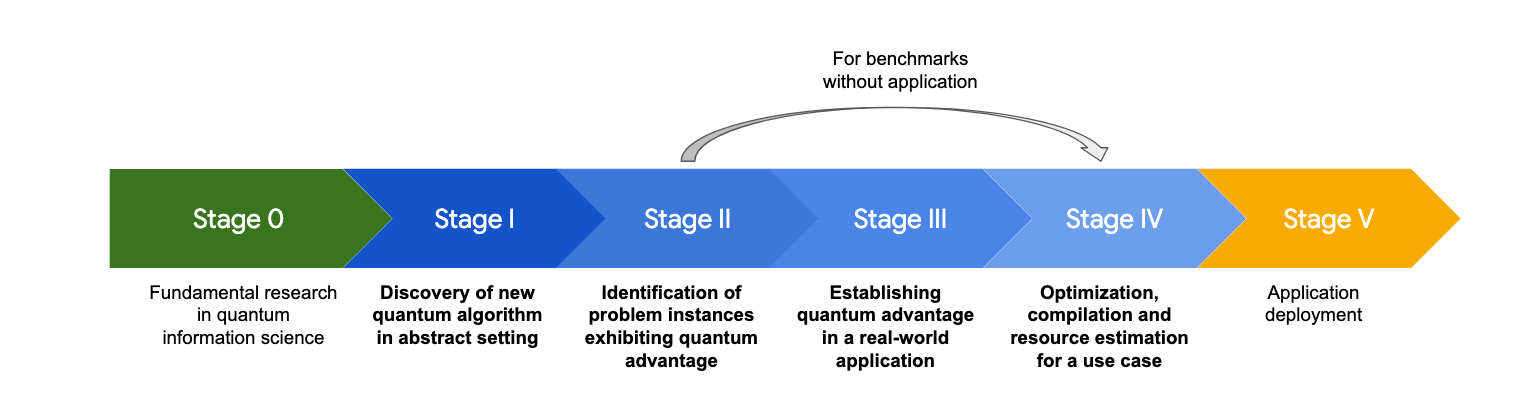
Three months prior to the Mohseni paper’s third revision, nine scientists from Google Quantum AI led by Ryan Babbush and Robbie King posted The Grand Challenge of Quantum Applications. The Babbush paper is about what the hardware would run if it existed. The answer, set out in a compendium of candidate Stage III applications, is that outside of cryptanalysis and quantum simulation, essentially no practical use case for quantum computing has yet been shown to survive real-world constraints while retaining a super-quadratic speedup. The paper’s most striking passage is a warning about “the economics of quantum application discovery” — that the field faces a collective-action problem in which hype about timelines and applications may burn through public trust. Mohseni pushes the hardware timeline back by decades. Babbush catalogs the thinness of the software case the hardware is meant to justify. Neither was reported by the trade press as bad news. Both are.
I began writing The Longest Calculation because I believed what the field was saying to the public and what it was saying to itself were becoming too wide a gap to leave uncorrected. Fifty-one insiders just wrote down where the difference actually is.
The oracle from Givat Ram used to say that there is no quantum magic, only quantum probability. The question is always whether the machine can actually prepare the useful physical state.
We have a long time ahead of us to settle this bet.