
Your Environment Has a Longer Memory Than You’d Like
What is this thing, non-Markovianity, that I keep hammering?

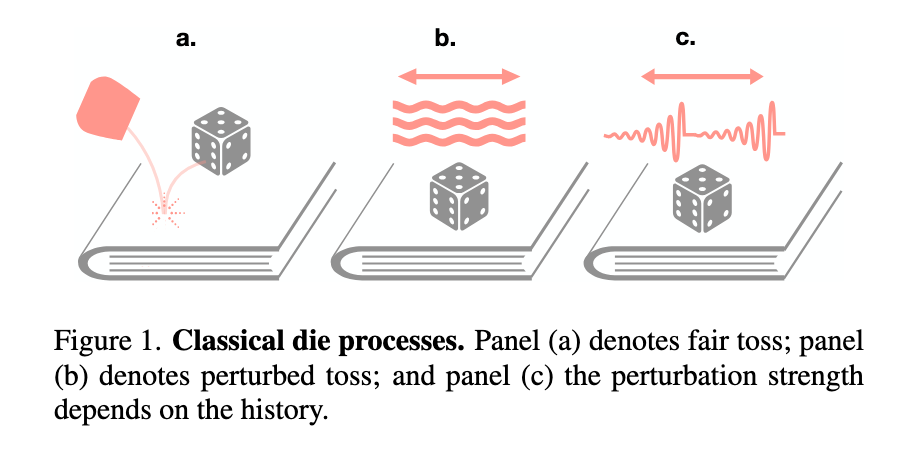
Let’s start with a die. If you shake it hard between every roll, the outcome is completely random — the die has no memory of what it just showed. Past rolls tell you nothing about the next one. Mathematicians call this a process with Markov order zero, which sounds fancy but just means: the die couldn’t care less about its own history. Think of a golden retriever. Every walk is the first walk. Every stranger is a new best friend. No grudges, no context, no continuity.

Now imagine the die resting on a book, and you give it a gentle nudge. Suddenly the current face matters — the die is probably going to stay put. But only the current face matters; what it showed three rolls ago is irrelevant. That’s a Markov process: it remembers one step back, no more. This is your average teenager. They have no idea what happened at Christmas 2019, but they remember with crystalline precision that you forgot to buy the right cereal last Tuesday, and they will factor that into today’s mood.
The truly wild case is when the shaking intensity changes based on how long the die has been showing the same number. To predict the next roll, you need to remember the last several results. This process has deep memory — and it’s the regime where most trouble in quantum physics comes up. It is also, uncannily, your mother-in-law. The probability that Thanksgiving goes well depends not just on what you said last week, but on what you said in 2011, the look you gave in 2014, and a comment she is fairly certain you made once at a barbecue, though she concedes the year is hazy.
So what does any of this have to do with quantum computers?
A qubit doesn’t exist in isolation. It’s constantly talking to its surroundings: stray magnetic fields, vibrating atoms, laser fluctuations, neighboring qubits. That surrounding mess is the “environment.” The question is how good the environment’s memory is.
If the environment is Markovian, it absorbs whatever noise it inflicts on your qubit and promptly forgets about it. Each error is independent. Your error correction schemes can assume this and they’ll work. Life is good. The environment is the golden retriever.
If the environment is non-Markovian, things get spicy. Information the environment soaked up from your qubit at some earlier moment can come sloshing back — like a bathtub you thought had drained but suddenly fills up again. This “information backflow” can temporarily undo some decoherence, which sounds great until you realize the errors your qubit suffers today are now correlated with errors it suffered a moment ago. Standard error correction codes, built on the assumption of memoryless noise, can fail in subtle ways. The environment is your mother-in-law, and she brought notes.
How do you even measure this?
This review paper by Milz and Modi lays out the modern framework. The central object is called the process tensor — a complete description of everything an environment can do to a quantum system across multiple points in time. If the process tensor is a product of independent pieces, you have a Markovian process. If it has cross-time correlations baked in, you have non-Markovianity, and you can quantify exactly how much memory the environment is carrying.
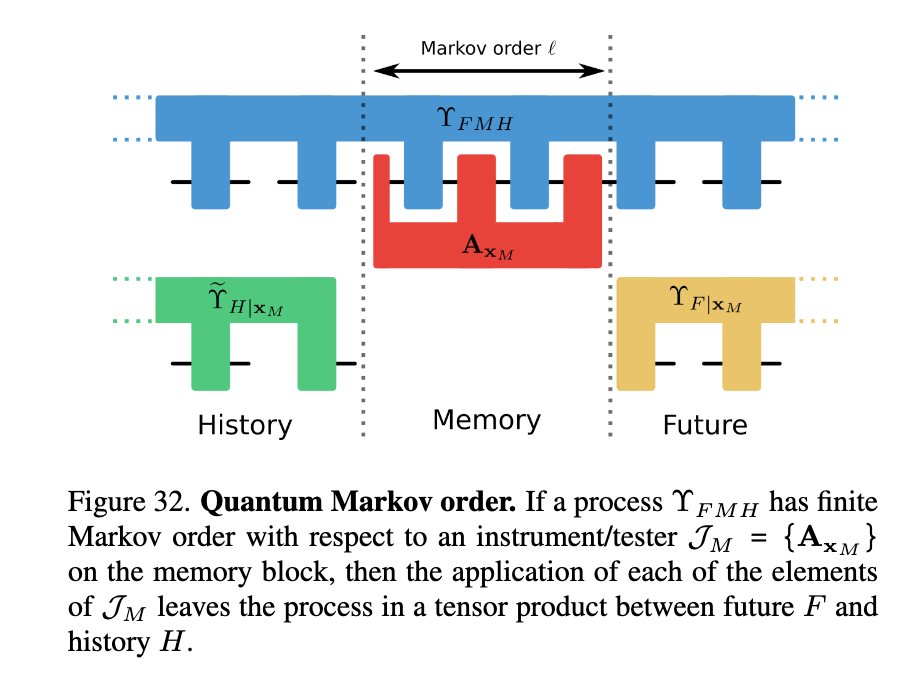
The elegant and slightly unsettling punchline: you can have a process that looks perfectly Markovian from every two-point measurement you make, and then you apply one intermediate operation and suddenly the dynamics reverse — information floods back in. This was shown explicitly in what the paper calls the “shallow pocket model,” and it’s a demonstration that non-Markovianity is fundamentally a multi-time phenomenon. Two snapshots won’t catch it. You’d need to actually poke the system in the middle — which is, coincidentally, also the only reliable way to find out whether your mother-in-law is still thinking about that barbecue.
What this means for quantum error correction
Nearly all quantum error correction theory is built on the Markovian assumption: errors at different moments are independent. This simplifies everything enormously, and the fault-tolerance thresholds — the maximum error rate a computer can survive and still function — are derived under this assumption. When the environment has memory, those thresholds shift, correlations between errors can fool syndrome measurements, and codes that should work don’t.
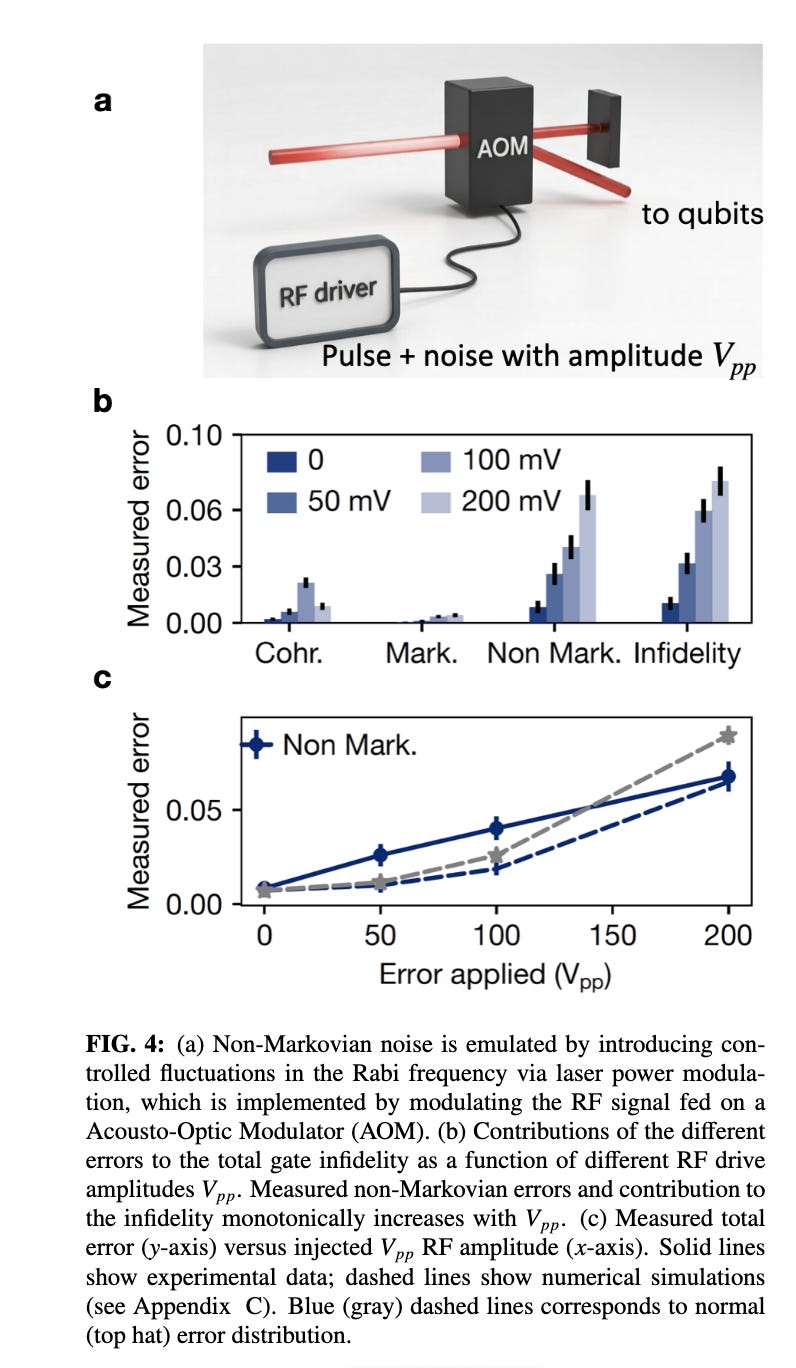
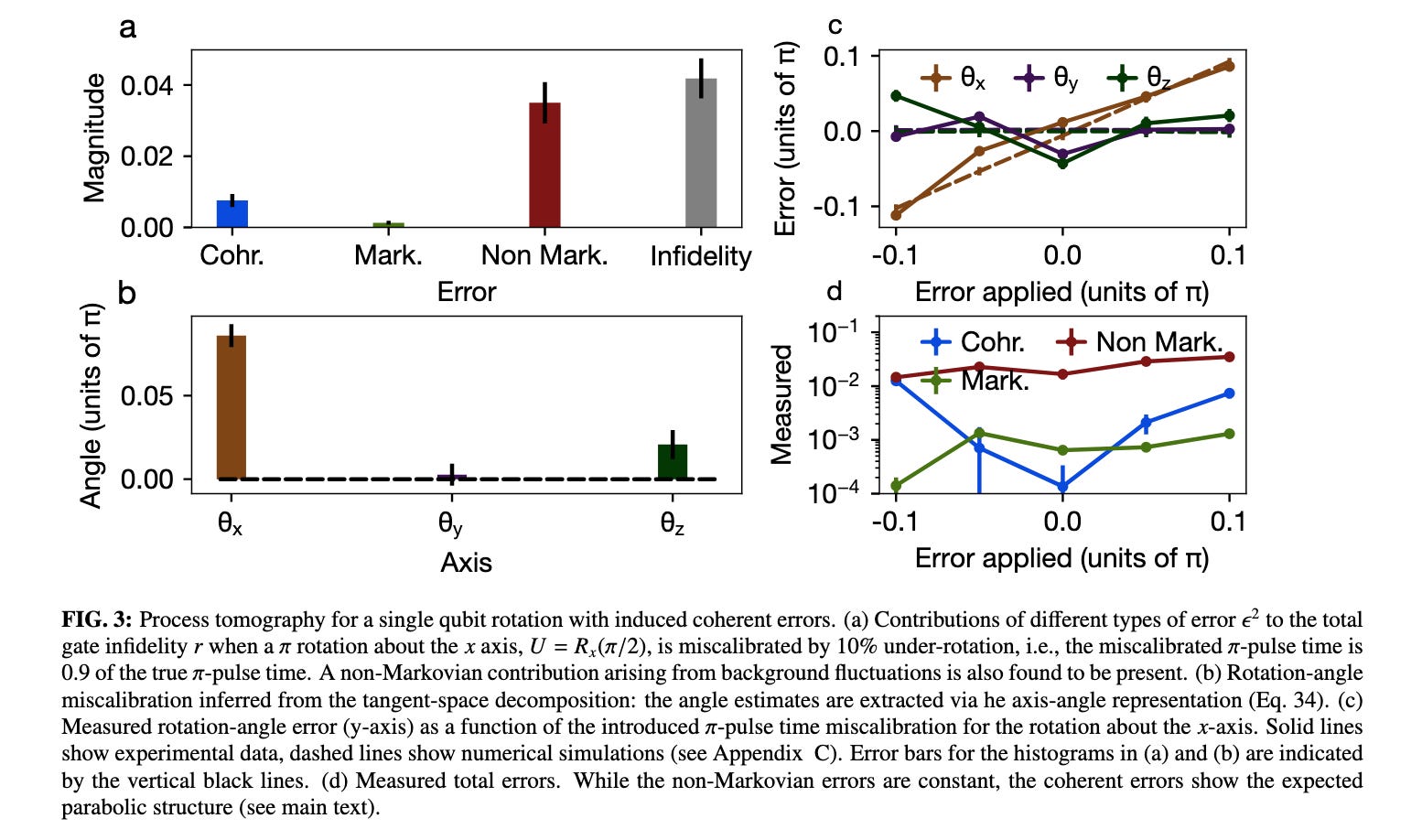
This is exactly the territory that a recent paper from K. Birgitta Whaley’s group at Berkeley (with a Los Alamos collaboration) steps into. Working on a trapped calcium-ion qubit, they developed a technique called tangent-space decomposition that takes a single tomographic snapshot of a quantum gate and automatically splits the error into three physically distinct buckets — coherent miscalibrations, ordinary Markovian noise, and non-Markovian contributions — without assuming any particular noise model. By deliberately injecting controlled non-Markovian fluctuations via laser power modulation, they showed the method correctly identifies and quantifies memory-driven errors even when those errors are smaller than the background noise. It’s a practical, low-overhead diagnostic tool, and the kind of thing that becomes essential the moment you want to move from idealized error budgets to the real, grudge-holding environments inside actual quantum hardware.
The qubit, at least, has an excuse — it’s only two levels. The mother-in-law is operating in a much higher-dimensional Hilbert space.
The census
While the Berkeley group built a microscope for one ion, a team at Johns Hopkins led by Gregory Quiroz, with a coauthor inside IBM Quantum, went and took a census.
Submitted in December 2024 and published in PRX Quantum in May 2026, their study characterized 39 qubits across seven of IBM’s cloud-accessible superconducting processors, the machines anyone can rent by the hour. Using nothing fancier than carefully chosen sequences of ordinary gates, they sorted every qubit by the kind of noise it suffers.
The result:
Roughly two thirds behave like the golden retriever, no memory whatsoever.
The remaining third hold grudges.
About a quarter of all qubits carry noise correlated in time.
Another tenth suffer correlated errors in the control signals themselves, and these grudges are stable: a qubit that remembers today will still remember next week.
Then they ran the experiment that should end the argument.
They took a small quantum chemistry calculation, the kind of demo the industry loves, and predicted its outcome with two models trained on the same hardware data. Their full model, which keeps the memory, predicted the machine’s behavior to within half a percent. A version of the same model with the memory deliberately erased, forced to assume each error is independent, missed by a factor of seven.
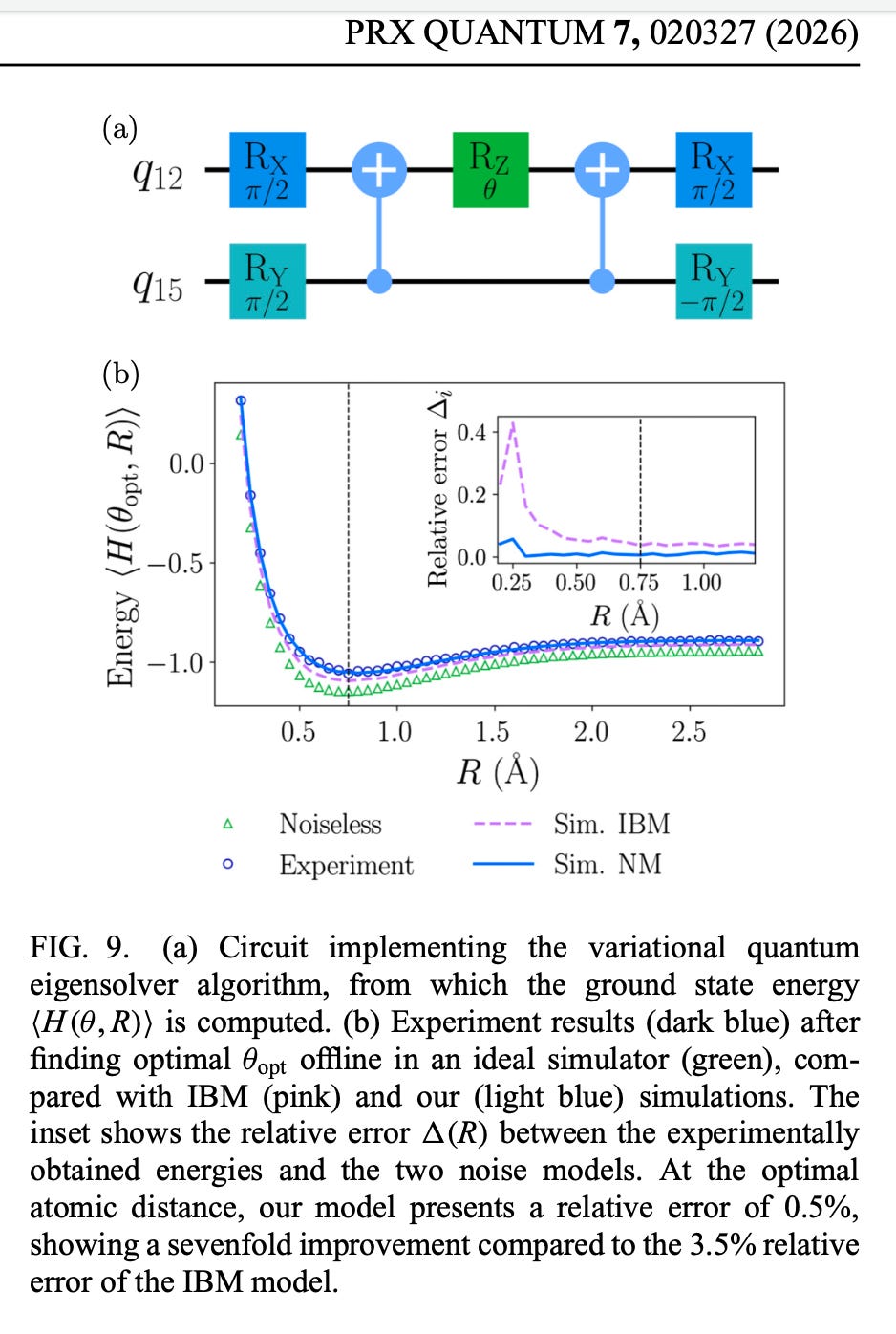
A factor of seven!
Same chip, same data, same everything; the single assumption of forgetfulness was the entire difference between a model that works and one that fails. Their toolkit descends from the noise-spectroscopy school of Lorenza Viola and collaborators, the line of work that spent two decades learning to read an environment’s spectrum the way an audio engineer reads a frequency response, and from Lidar’s open-systems machinery (the same Lidar who, with Alicki and Zanardi in 2006, questioned whether the threshold theorem’s memoryless assumption was even physically consistent). That tradition runs through their references like a watermark.
This is, by now, the third corner of the triangle you, dear readers of this Substack, have been exposed to. It is also the most awkward one for the industry. Melbourne (Kam-Modi and colleagues, who were the heroes of our Willow fable) derived the breakdown in simulation from physical assumptions. Berkeley and Los Alamos (Perego-Whaley and colleagues) built an instrument to dissect a single gate. Johns Hopkins (Quiroz and colleagues) surveyed the commercial fleet and found a mother-in-law sitting in one of every three chairs, on hardware bearing the logo of a major lab, in a paper carrying that lab’s own coauthor.
None of these three groups coordinated, and they barely cite each other; they converged because the physics left them no choice. The memoryless environment was an assumption of convenience, made in the 1990s so the theorems would close. It was also an assumption of necessity: you have to start somewhere to build these machines. But the machines have now been asked directly, three different ways, on three different platforms, and they keep giving the same answer: they remember.
This entire Substack has repeated a point I first made twenty years ago, hammering how crucial non-Markovian noise is to the question of fault-tolerant quantum computing. Now you know what it means, how to measure it, and, most importantly, that it’s real.