
Why Quantum Computing Is the Longest Bet in the History of Technology
The Longest Calculation: Quantum Computing, an Inside Story. Forthcoming Book. Episode I

In 1981, Richard Feynman stood up at a conference at MIT and suggested that if you wanted to simulate quantum physics, you would need a computer that was itself quantum mechanical. It was a beautiful idea. It was also, as Feynman cheerfully admitted, a problem that did not look so easy.
Forty-five years later, it still does not look so easy.
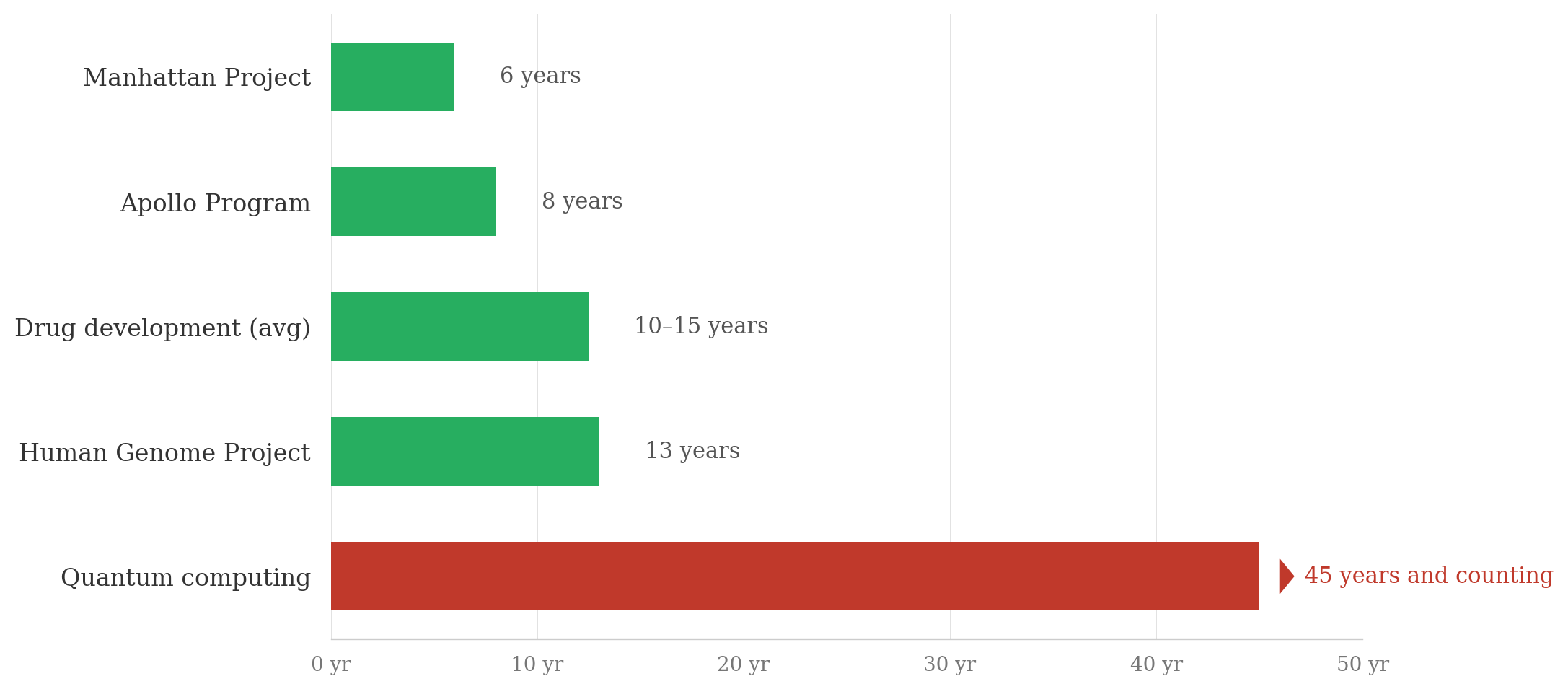
Consider the arithmetic. The Manhattan Project took six years from concept to detonation. The Apollo program took eight from Kennedy’s speech to the Sea of Tranquility. The Human Genome Project, which seemed impossibly ambitious when it launched in 1990, delivered a draft sequence in thirteen years. Big pharma, the slowest of the industrialized sciences, develops a drug in ten to fifteen years from target identification to approval, and most candidates fail along the way.
Quantum computing has been underway, depending on where you start the clock, for somewhere between thirty and forty-five years. There is still no machine that can do anything a classical computer cannot do more cheaply. The most celebrated milestone in the field’s history, Google’s 2019 quantum supremacy demonstration, involved a processor that solved a problem specifically designed to be hard for classical computers and easy for quantum ones. It was a genuine achievement. It was also, by the admission of nearly everyone involved, not useful. The distance between that demonstration and a machine that could, say, break the encryption protecting your bank account is a matter of conceptual leaps that have yet to be made.
This is a timescale.
The pharmaceutical industry burns through billions on candidates that never reach the market, and nobody calls drug development a fraud. Space agencies spent decades on propulsion problems that yielded no immediate return, and nobody called rocketry a hoax. Quantum computing operates on a longer timeline than either, and with a harder scientific problem at its core: the physical world destroys quantum information faster than engineers can protect it, and the mathematical theorems that promise a solution demand resources so extravagant that the solution may be, for practical purposes, indistinguishable from the problem.
Governments know this. They are spending billions anyway. The reason involves encryption, and it is a story I will tell, but later, because understanding why it matters requires understanding what quantum mechanics actually offers computation, what it does not offer, and how a scientific idea becomes a commercial industry before anyone can prove it works.
That story, which I watched unfold from the inside over two decades as a philosopher of physics and then left for a career in biomedicine, is the subject of my forthcoming book, The Longest Calculation: Quantum Computing, an Inside Story. Over the next fifteen posts, I will open some of its doors. A man on an island, before the money arrived. A philosopher in Jerusalem who saw around a corner the computer scientists had not reached. The theorems that saved the field, and the fine print nobody reads.
It begins with two men arguing about whether the universe computes, one of them famous and the other one right, on an evening in Pasadena half a century ago.
We are, by any honest accounting, still at the beginning.