
The Quantum Advantage Bind
Why every advantage claim is verified right up to where it matters

There is an inherent problem at the center of every quantum advantage claim, and it has nothing to do with any particular company, machine, or hardware modality. It comes from the logic of the claim itself. Once you see it, the last eight years of announcements reorganize themselves into a single pattern, and the pattern is not flattering, but it is also not anyone’s fault. It is a bind, in the strict philosophical sense: two horns, no third option.
Here it is in one paragraph. A quantum advantage claim says: our machine produced an answer that no classical computer can produce. To believe the answer, you have to check it. But the only general way to check a quantum computation is to run it on a classical computer and compare. So if the answer can be checked, a classical computer just produced it, and the advantage is gone. And if the answer cannot be checked, then it has not been checked, and what you have is a claim, not a result. Checkable means matchable. Unmatchable means unchecked.
Imagine a footrace in which the referee is the other runner. If the referee keeps pace with you all the way to the finish line, you did not win the race. If the referee falls behind, nobody timed you. Every quantum advantage demonstration to date has been this race. The verified portion of the experiment is the portion where the classical referee kept up. The advantage portion is the portion where he fell behind, which is also, necessarily, the portion nobody witnessed.

What is happening in that unwitnessed region? The machine does not stop working there. It keeps running and it keeps producing numbers. Those numbers come from a physical system evolving under the laws of quantum mechanics, exactly as such systems have evolved since before anyone measured them. Running a physical system and recording what it does is a perfectly respectable activity. It is called an experiment, and physics is built out of experiments. But there is a difference between an experiment and a computation, and the difference is the check. A computation is an answer to a question, and answers can be right or wrong. An experiment past the frontier of verification is a measurement waiting for a second opinion. The advantage claim asserts that the second opinion is impossible. It cannot then also assert that the first opinion is confirmed.
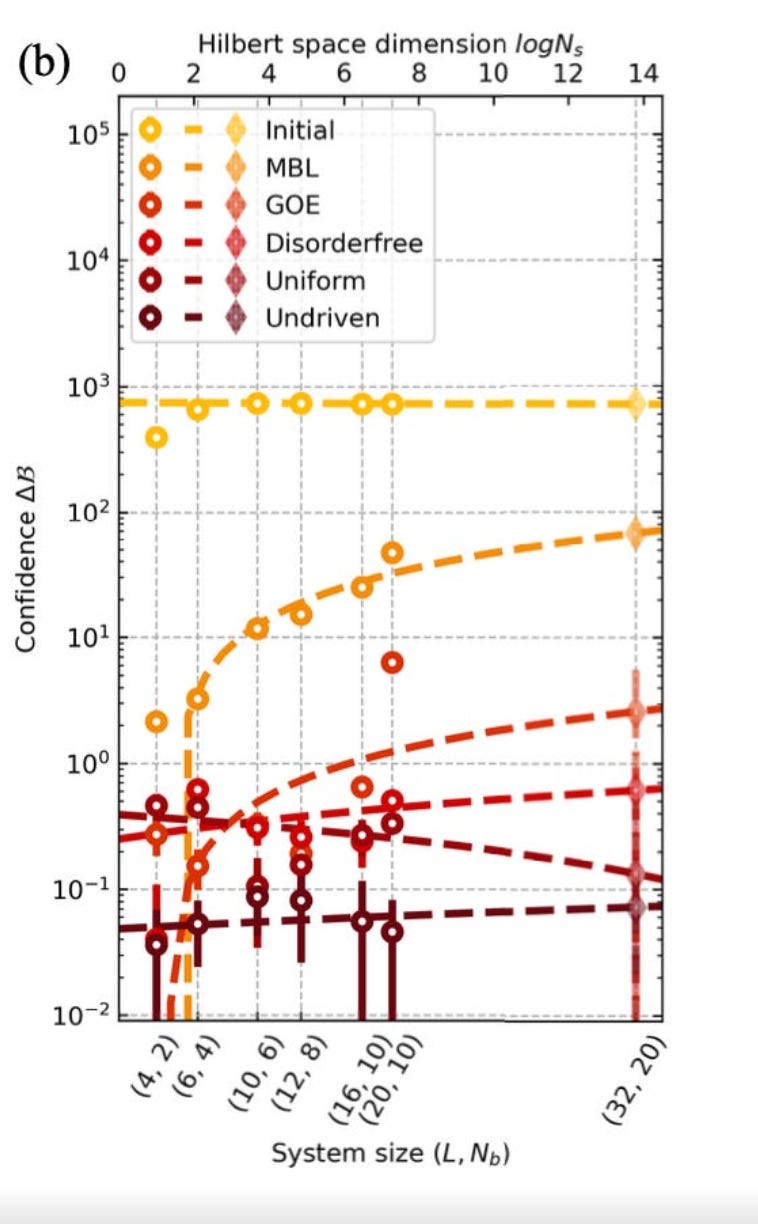
In practice, the demos handle this with a border crossing. The machine is verified in the region where classical methods reach: small sizes, short times, simple observables. There it agrees with the classical answers, which establishes that the machine works. The advantage is then claimed in the region where classical methods do not reach, and the trust earned on the near side of the border is carried across to the far side. The trouble is that trust does not travel all that well. Error rates that were measured where checking was possible are assumed, not measured, where checking is not. The standard tools of the trade make the assumption explicit: error mitigation schemes are trained and calibrated in the checkable region, then applied in the uncheckable one. The verified regime lends its credibility to the unverified regime, and the loan is never inspected.
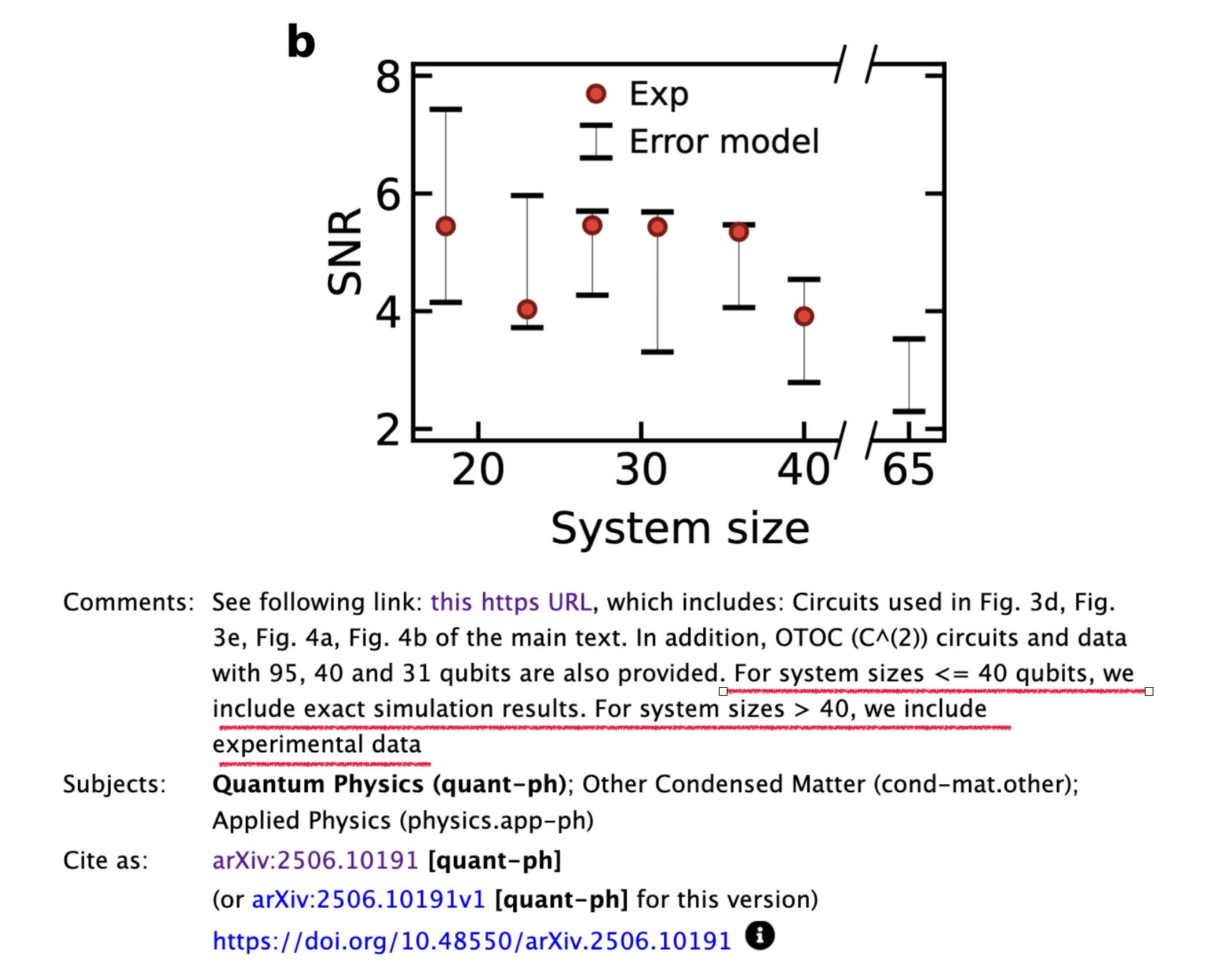
Two recent experiments show the two faces of the bind with unusual clarity, and I describe them here in general terms, without dwelling on the actors. In one, the machine’s output was verified against exact answers up to a certain size, and the advantage was claimed at a substantially larger size, where the accuracy rests on a projection from the machine’s own error model and a rescaling factor calibrated on the machine’s own small-scale behavior. The referee for the large claim is the machine’s opinion of itself. In the other, a classical method constructed after the fact followed the machine as far as any check exists; the two agreed everywhere both could go, disagreed in the hardest corner that was still checkable, and past that corner there is simply silence. Not because the machine is wrong there. Because no one, including its builders, can say whether it is right.
There is a caveat (there is always one). Theoretical computer science has produced elegant interactive protocols in which a classical verifier can, in principle, check a quantum computation without simulating it, using cryptographic tools. These results are real and important. But here is the point: no advantage demonstration has used one, and the sampling-style demonstrations that dominate the record cannot, by their mathematical structure and by the flat distributions they produce, be verified that way from samples alone. So the bind is not a theorem about all possible futures. It is a description of every demonstration actually performed so far.
Is there an exit? Yes, and it has been visible since 1994. Shor’s algorithm factors large numbers. If a quantum machine ever factors one, no one will need to simulate the machine to check the result. You multiply the factors back together and compare. The check takes seconds and requires no quantum mechanics at all. The special case points at the general rule: an advantage claim becomes verifiable at exactly the moment the output is used for something whose success can be judged on its own terms. Break a code, and the broken code is the proof. Predict a molecule, and the synthesized molecule is the proof. The certificate goes hand in hand with the answer once the answer is useful, because the verification migrates out of the physics and into the application. The application is the only referee that does not dissolve the advantage by catching up to it.
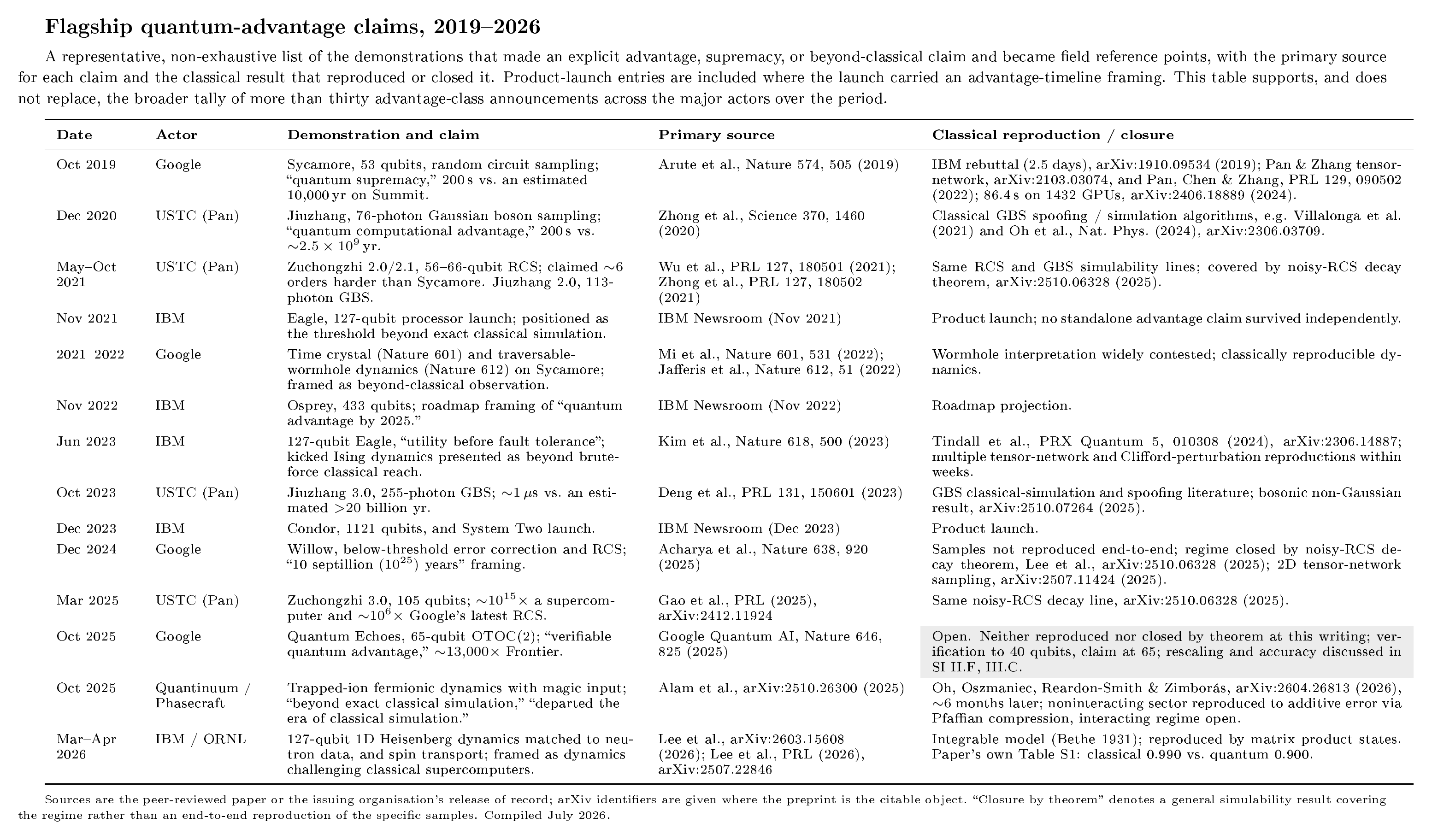
This also explains a curious feature of the “advantage” record so far: the demos are always sampling tasks, correlators, benchmark statistics, and never anything anyone independently wanted. The tasks are selected to be hard to simulate. Hard to simulate means hard to check. A result that cannot be verified is a result that cannot be refuted, and the two properties are easy to confuse from a distance.
And if you are reluctant to believe a philosopher of physics, try this. Four of the field’s senior theorists propose these same criteria: a recent Perspective in PRX lists verifiability and usefulness among five keystone properties of an ideal quantum advantage. The record above is what happens when demonstrations are scored against exactly those two.
None of this is an argument that the machines are useless or the engineering hollow. The engineering is real, and the bind is not the engineers’ invention; it is a property of the kind of claim being made on their behalf. It is an argument about what would count as evidence. The standard is short enough to remember:
Show the answer being used, not compared.
Until a demo meets it, every advantage claim divides into the part that was checked, where the classical methods kept pace, and the part where the machine pulled ahead, where the only witness is the machine itself.

There is a picture underneath all of this, and it is the picture this newsletter keeps returning to. Draw two regions: what classical computers can reach, and what quantum machines can. The second is believed to be larger; that belief is a conjecture, and nothing here disputes it. Every demo of the past eight years has taken place inside the overlap, and not by accident. Noise is the fence. A noisy machine can hold together only the shallow circuits and the structured ones, and shallow-and-structured is the overlap’s definition. The region beyond the fence is where quantum advantage resides, and by the argument above it is also the region where, today, no witness can follow. There is one door through the fence, and it has been on the blueprints since 1996: fault tolerance. The claims of the past eight years were written as if the field had already walked through it.
The machines are still on this side.
July 24 2026. Note added in proof.
On July 23, a multitude of authors all working within the neutral atoms modality posted a 135 pages paper to the arXiv with the title “Strategic Plan for Neutral Atom Quantum Computation”. It’s a careful one, and it contains several admissions, straight from the mouth of the cheetah, so to speak. Here are some: random circuit sampling demos “are not verifiable in the advantage regime” (Sec.1); verification remains in limbo, with extrapolation required and benchmarks open to classical attack (Sec. 1.1); a custom-built task risks being hard classically only because nobody studied it, with IBM’s kicked Ising named as the case where the target collapsed the day after (Sec. 1.1); state-of-the-art size and state-of-the-art fidelity have never run in the same machine (Introduction, after Fig. 2); for sampling tasks, inefficient verification appears inevitable (Sec. 1.2.2). It also boasts with Moore’s law extrapolation (qubits ×1.8 per year, errors ×0.6 per year, yielding “quantum utility within the next decade”), while excluding early results from the trend line.
But all this is immaterial. The real reason I bring it here, a week after this post went up, is that the authors actually agree with my bind framing in their section 1.2.2 on verification. The vendors’ own scientists endorse the whole thing: classical verification, interactive proofs, quantum “verification” (when there is no one who can check). That’s great. I’ll take it.
The one step they are still unable or unwilling to make is the conclusion I draw, namely, that every demo run so far sits on the wrong side of their own taxonomy. Their paper is a research agenda, a result of a Town Hall they all had with the NSF some eighteen months ago. This post is a verdict on the existing record. And it beat their write-up by a week.
Yet another loss to quantum advantage.