
The Heat That Sees Magic
The Threshold Theorems - A Trilogy. Part I

Several days ago, a group of physicists in Brazil and Denmark posted a paper to the arXiv with the best title of the year: Every Little Thing Heat Does Is Magic. Sting and the Police sang about love. Macêdo and his six coauthors were writing about a deep technical problem, and they solved part of it. You can certify, they showed, that an unknown quantum state possesses magic by measuring only its energy and the heat it exchanges with a thermal bath. No state tomography. No single-particle addressing. A thermometer and a calorimeter. That is the whole apparatus.
A word about magic, because the term is real and the physics is beautiful.
Quantum computation has two currencies. The first is entanglement, the correlation-without-classical-analogue that Einstein called spooky, John Bell proved unavoidable, and Pitowsky nailed as a necessary but insufficient resource for quantum speedup. The second, discovered more recently, is nonstabilizerness, or magic. Here is the surprise. Entanglement alone does not get you out of the reach of a classical computer. A theorem of Daniel Gottesman (who credited Emanuel Knill), dating to the late 1990s, shows that an entire family of highly entangled quantum circuits, the so-called stabilizer circuits built from Clifford gates (a small, well-behaved family of quantum operations — the Hadamard, phase, and CNOT gates — that shuffle Pauli operators into other Pauli operators), can be simulated efficiently on a laptop. You can have a Bell pair, a GHZ state, a hundred qubits in a maximally entangled cluster, and the classical machine keeps up with the quantum hardware. What a classical computer cannot do is simulate a quantum circuit that injects a non-Clifford gate, typically a so-called T-gate, a rotation by forty-five degrees in the right plane. That rotation produces states outside the stabilizer manifold. Those states are the magic. They are the fuel. Every fault-tolerant quantum computer built or proposed today spends most of its resources distilling and consuming them, because without magic all you have is an expensive piano with only the white keys.
The ability to detect magic, therefore, matters. Full quantum state tomography scales exponentially in the number of qubits and stops being possible around twelve. Cleverer methods have been proposed over the past five years, but each one depends on access to particular correlations the experimenter has to measure, often with apparatus that does not exist. What Macêdo and his coauthors propose is a witness of a different kind. Define the stabilizer gap as the distance between the ground-state energy of a Hamiltonian and the lowest energy any stabilizer state can achieve. Any state whose energy sits below that floor must contain magic. Picture a row of tiny compass needles with a sideways push: there is a tipping point between “all lined up” and “all sideways,” and at that tipping point the amount of magic peaks, falling off in the dull limits where everything points one way or the other. You can read this off the chain’s energy. When the energy reading is inconclusive, a second measurement — heat exchanged with a small helper system — resolves the ambiguity. The experimental input collapses to a pair of numbers.
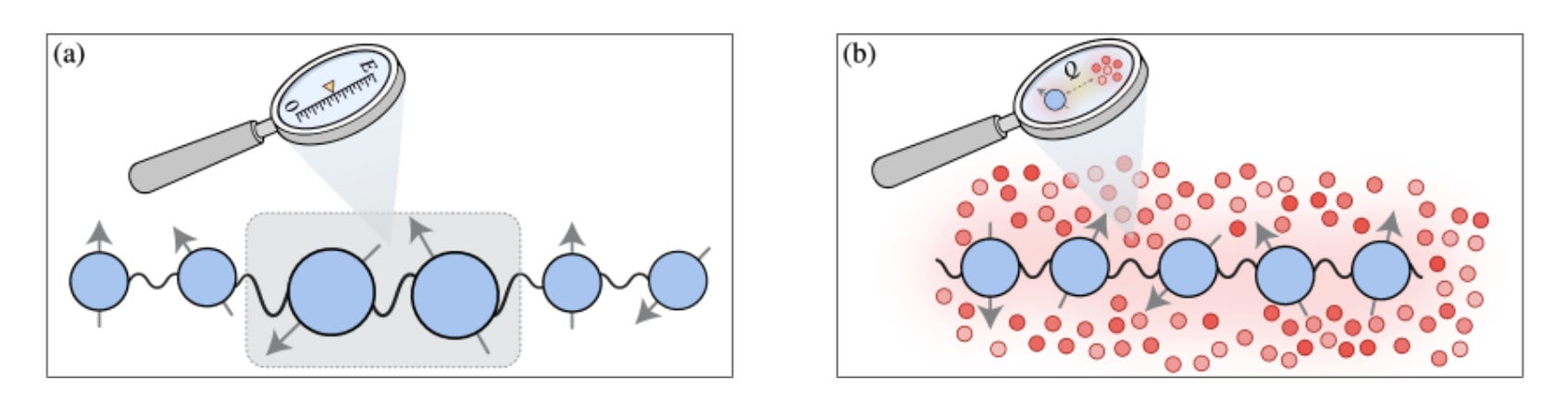
This result has a lineage going back to 2003. Over the two decades since, thermodynamic observables became the standard tool for detecting entanglement in real materials, an arc Pontus Laurell and three colleagues at Oak Ridge consolidated in a review last April. One year later, the same architecture reaches into magic.
Here is where Itamar Pitowsky arrived first, and where the story I keep coming back to begins. In April 2004, Pitowsky posted a preprint called Random Witnesses and the Classical Character of Macroscopic Objects. He asked a precise question in a precise way. Why is it that macroscopic objects, even if their constituents were somehow shielded from decoherence, would still not appear to us as entangled? In other words, why can’t we see too many Schrodinger’s cats around, even though quantum theory tells us they exist? His answer was geometric. An entanglement witness is a kind of detector: you point it at a quantum state, read off a number, and if that number climbs above one you have caught something genuinely entangled. Separable states — the classical, unremarkable ones — always register below the threshold. The louder the detector can ring, the more entangled states it can flag. Pitowsky showed, for a natural class of these witnesses, and conjectured more widely, that as you add qubits the ceiling on that ringing rises only at roughly the pace of the square root of n log n — a crawl compared to the exponentially large Hilbert space the witnesses are trying to police. In other words, witnesses capable of detecting generic entanglement in a large system are exponentially rare.
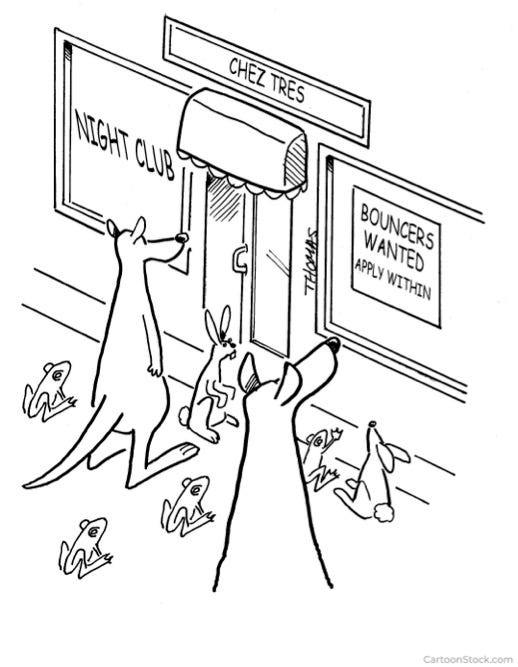
The simplest way to picture this is to imagine you are hiring a bouncer to stand at the door of a nightclub and distinguish entangled states from separable ones. Almost every bouncer you could conceivably hire is face-blind. They cannot tell an entangled state from a separable one if their life depended on it. The bouncers who actually see the difference exist, in principle, but they are vanishingly rare, and you need to know in advance exactly which face each of them is trained to recognize. Hiring at random gets you a bouncer who waves everyone in. To get the right bouncer you have to know the state you are looking for and commission a specialist for that particular job. In this picture the nightclub is the bulk material, and the bouncers are the observables. Quantum theory is happy to describe both, but the statistics do what they always do.
This is Boltzmann’s architecture (“violations of the 2nd law are possible but are highly improbable”) transplanted into operator space. In 2006, Meir Hemmo and I published a paper in Foundations of Physics called Explaining the Unobserved — Why Quantum Mechanics Ain’t Only About Information, in which we used Pitowsky’s random-witnesses idea to argue that the macroscopic world appears classical because the observables that could reveal its quantum character are, for essentially Boltzmannian reasons, too rare to encounter in practice. I returned to the same idea in a 2012 paper for a special issue of Philosophical Transactions of the Royal Society A on decoherence. The common explanation, that decoherence destroys macroscopic entanglement by scrambling phases, is correct as far as it goes but incomplete. Pitowsky showed that even with decoherence turned off, even in the idealization where the object has been perfectly shielded from its environment, you still could not see its entanglement. There would be nothing to see with. The witnesses needed are too rare, their operator norms too small, to cross the detection threshold.
What Macêdo and his coauthors have done, and what Laurell’s review consolidated one year earlier, is document the other face of that coin. The rare witnesses that do survive, that do have enough operator norm to see across a macroscopic system, are the thermodynamic ones. Susceptibility. Heat capacity. Dynamic response. Energy gaps. Heat exchange with a bath. These are the bouncers who are not face-blind. They are the vanishingly rare specialists whose eyes are trained on exactly the right states. The quantum-critical ground state of a spin chain leaves a thermodynamic fingerprint, and the fingerprint is there because of a rare alignment between what the material is doing and what our instruments can feel.
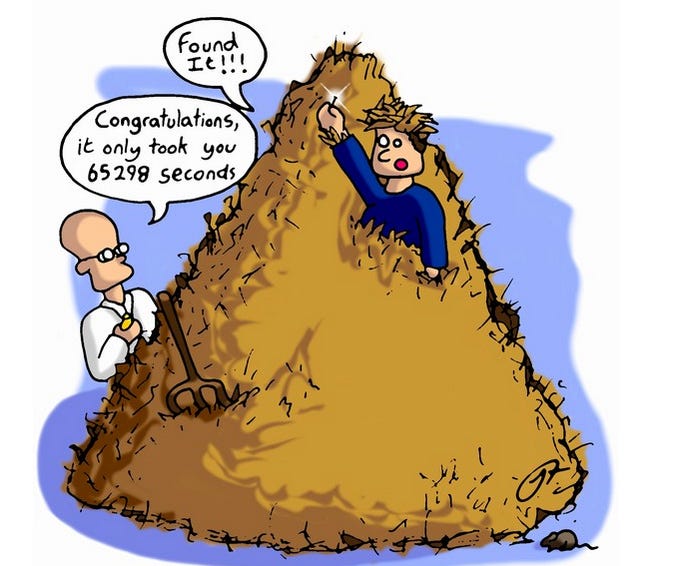
Macroscopic objects look classical because the observables that would betray them as otherwise are drowning in an exponentially larger sea of observables that see nothing. Entanglement is common. Witnesses are rare. Magic, as of April 2026, turns out to be witnessable too, by the same improbable trick. Thermodynamics catches what almost nothing else can catch, and it does so because it happens to be one of the few places on the dial where the signal rises above the static. The needle in the haystack exists, and the needle, as luck would have it, conducts heat.
Next: Part II, The Two Hidden Costs