
How Money Changes What Scientists Are Willing to Say
The Longest Calculation: Quantum Computing, an Inside Story. Forthcoming Book. Episode XI

A pattern repeats across this series, and it is worth naming precisely. A genuine scientific contribution, produced with care by people who understand its limitations, is taken up by a system — academic, commercial, or both — that needs the contribution to be larger, cleaner, and more decisive than it actually is. The limitations are quietly dropped. The caveats are stripped away. What remains is a claim that the original authors would recognize but would never have made in those words.
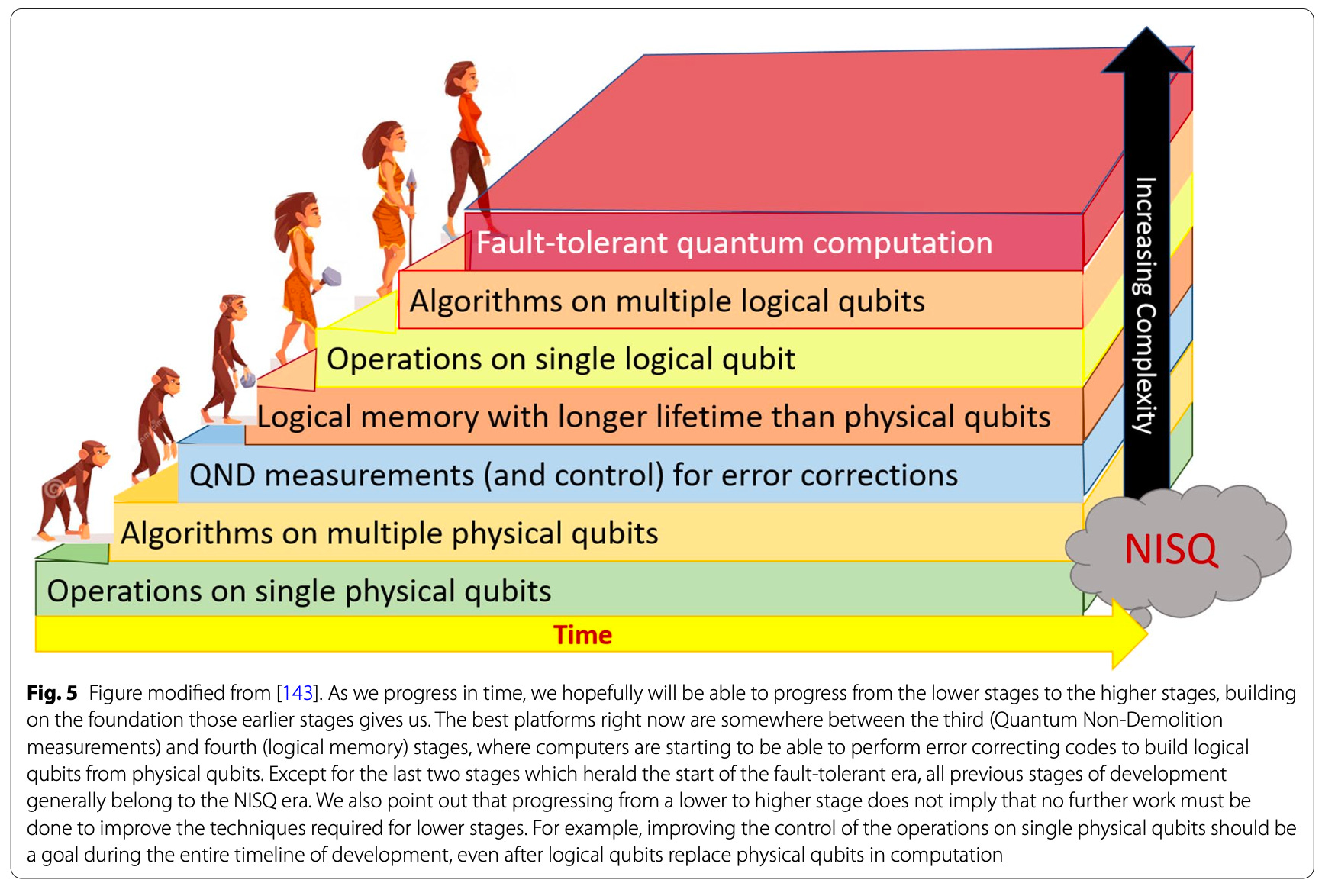
The threshold theorem said: if the noise satisfies certain assumptions, fault tolerance works. The press releases said: fault tolerance works. The word “scalable” entered the investor vocabulary, deriving its authority from a theorem that most of the people using the word had never read. John Preskill at Caltech, who understood the gap between mathematical proof and physical reality better than anyone in the field, filled his lectures with caveats the popular accounts invariably omitted. In 2018, he coined the term NISQ — Noisy Intermediate-Scale Quantum — an honest concession that fault-tolerant machines were further away than the theorems suggested. His public writing was a model of scientific integrity, consistently reminding audiences that “if the noise is below this level” is doing all the work in the sentence.
Last week, Caltech issued a press release announcing that a team including Preskill had found that useful quantum computers could be built with as few as 10,000 qubits, down from previous estimates of a million or more. The results, the release noted in passing, are theoretical. The press release also announced a startup, Oratomic, founded to commercialize the finding. Preskill told Caltech’s press office: “Now at last we’re getting close.” The release declared that fault-tolerant quantum computers “could be on the horizon” and “could, in theory, be operational by the end of the decade.” The conditional language was there, buried in a sentence whose momentum carried the reader past it. The man who spent two decades insisting on the distance between theorem and reality is now co-founding a company whose success depends on closing that distance. The caveats survive, technically. They just stop doing any work.
In February 2007, D-Wave demonstrated a sixteen-qubit processor at the Computer History Museum in Mountain View. The machine solved a Sudoku puzzle and a small optimization problem. The press was ecstatic. The quantum computing community called it science by press conference. Rose himself later admitted to MIT Technology Review that the Orion was approximately a hundred times slower than a conventional computer running the best known algorithms. Each press release was only slightly ahead of the data. Each investor presentation stretched the evidence only as far as investor presentations always stretch evidence. The cumulative effect, over years, was a gap between the public story and the scientific reality wide enough for the entire academic community to fall into.
A physicist in Australia claimed that quantum mechanics could solve problems that are mathematically uncomputable, transcending the barrier Turing established in 1936. The claim survived peer review repeatedly, in progressively better journals, because the error was subtle enough that referees trained in physics could miss it. The papers were published. The claim was false.
A review paper published in 2022, which acknowledged with admirable honesty every issue this series has raised — decoherence, the overhead problem, the absence of any useful quantum advantage, the possibility of a quantum winter — spent thirty pages carefully explaining how far away everything is, and still ended with the reassurance that “the field is worthy of investment.” Thirty pages of honest difficulty, followed by one sentence for the funders.
This is how capture works. A field under external pressure warps its own epistemology. The standards by which claims are evaluated shift, imperceptibly, from “is this true?” to “is this publishable?” and from “is this publishable?” to “will this attract funding?” The shift is not cynical. Everyone acts in good faith. The pressure is structural, and structural pressure is harder to resist precisely because no one is consciously exerting it.
Quantum computing provides an unusually clean example of this process, but the process itself is universal. Pharmaceutical companies fund trials designed to produce publishable results. Defense contractors frame incremental progress as breakthrough capability. The epistemology of a field bends toward the money, slowly, and the bending is visible only from outside, or from a distance of years. I watched it happen from the inside for two decades. The scientists I knew were honest and rigorous. The system they worked in was honest and rigorous about everything except the distance between what the science supported and what the funding required. That distance, maintained by good people for understandable reasons, is the subject of my book.