
Mind the gaps
The NISQ Trap, or, How to Waste Eight Years on Press Releases. Post 5

Four previous posts walked four sides of the loop. Four hardware platforms, four classes of de-quantization, one shape. So far, the current hardware that could run a NISQ demo with enough fidelity to publish was constrained, by the noise on its gates, to circuits a laptop could match, well, fine, sometimes not just a laptop but a GPU. The constraint and the matching are the same fact, written from two ends.
This is the synthesis. It states what the eight years amounted to scientifically, beside the tens of billions of dollars invested in quantum computing, and ends on a paper from October 2025.
The closed loop
The NISQ era ran from Preskill’s 2018 paper to the 2026 publication of the Mele theorem. Eight years. In that span, the four major US-listed quantum companies issued more than thirty-five advantage-class announcements; the comparable Chinese efforts brought the global total above fifty. Each announcement rested on a demonstration. Each demonstration belonged to one of four classes: random circuits, structured-Hamiltonian dynamics, variational algorithms, or structured-input dynamics. Each class admits a classical-simulation method that has been on the classical hardware’s menu between four and twenty-four years.
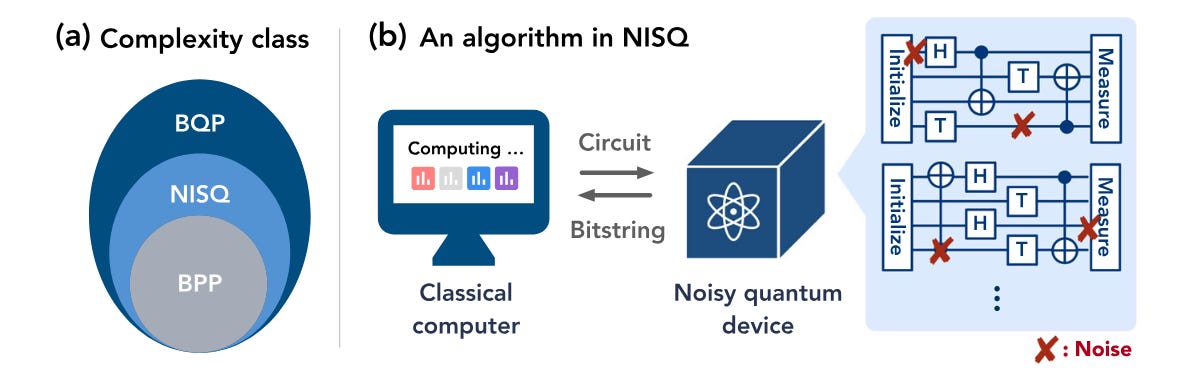
Closing of the loop is the recognition that, so far (that is, unless someone arrives tomorrow with a counterexample, and please, do try), those two lists describe the same set. The hardware ran the things it could run. The things it could run were the things the laptop could match. The advantage was always tomorrow’s, because today’s was, on inspection, the GPU’s.
What deserves credit is the engineering which was always real. Coherence times improved by a factor of ten over the period. Two-qubit gate fidelities improved from below 99% to above 99.9%. Qubit counts went from fifty to over a thousand on the leading platforms. Error correction passed below threshold for the first time, three times, twice on superconducting hardware and once on neutral atoms. None of this is in dispute (although, mind you, all these accomplishments were achieved for NISQ hardware under very specific assumptions on the noise that may or may not scale as the hardware scales, just ask Willow’s engineers about their figure 3b), and none of it required thirty-something press releases.
Hardware engineers, when they speak in their own voice, name a five-to-ten-year horizon for fault-tolerant useful computation, contingent on continued progress that is not guaranteed, and contingent on that unproved assumption on the noise I keep mentioning and they keep ignoring. The last part is mostly hope. DARPA initiative says “decades ahead”. The publicity apparatus has not waited five to ten years for anything. Phrases like “decades ahead” or “contingent upon” are unspeakable. The apparatus has produced an unbroken series of advantage announcements on a timeline of months, and the announcements have been timed to fundraising rounds and product roadmaps rather than to theoretical milestones. Unsurprisingly, de-quantization results enjoyed no similar cover and were followed by silence.
The two-year silence
Mele’s theorem is the one whose timing matters most for what follows. The preprint went up on March 20, 2024. It was cited by IBM and Google researchers within months. The result, that any quantum circuit on noisy hardware behaves like a short circuit once the qubit count is large enough, was readable by anyone with a graduate-level physics background and was understood by senior researchers at every major quantum computing company within weeks of publication.
Between March 2024 and the Nature Physics official version in April 2026 — twenty-five months — the industry continued to issue advantage announcements based on variational algorithms. IBM's November 2025 Quantum Developer Conference promised quantum advantage by the end of 2026, naming variational problems as one of three tracks toward that target. The Mele preprint had been public for twenty months at that point. The IBM announcement did not address it. I wrote about this silence, with a fuller chronology, in A Timeline of Silence.
A two-year silence on a result of that scope happens by design in a small field. The result was known. It went unmentioned because mentioning it would have required restating the commercial pitch, and the commercial pitch was the spine of the funding cycle. The technical community read the paper, cited it where they had to, and continued promising the deliverable the paper had ruled out.
The press rooms were working with information the engineering departments could have provided and in many cases did. Campaign messages went out intact regardless. That choice has a name in commercial law in most jurisdictions. As a courtesy, this series leaves the name unsaid.
The acronym refresh
In October 2025 a paper appeared on the arXiv with the title Mind the Gaps: The Fraught Road to Quantum Advantage. The authors are Jens Eisert and John Preskill. The paper coined a new acronym, FASQ — Forecast Advantage, Slightly Quantum. Nah, just kidding. Fault-tolerant Application-Scale Quantum, that’s the one — for the post NISQ era. The paper acknowledges the difficulties of the NISQ programme honestly and surveys the obstacles ahead. It announces what comes after.

Note the pivot. A vocabulary that organized the field’s expectations for eight years is being retired. Replacement is being made by senior figures whose authority on the matter is partly that they coined the previous vocabulary. The king is dead, long live the king. FTQC, NISQ, FASQ: the field has been cycling through one new four letters acronym every fourteen years, which is roughly the time it takes for the previous round’s promises to come due. Even more important, the fundraising deck for the new era can be drafted before the audit on the previous one is complete.
Engineers and senior theorists are a different constituency from communication departments that issue thirty-something press releases. Criticism of the latter is a separate matter from the work of the former. Senior theorists have largely been doing what theorists do: writing careful papers about what is and is not possible, including papers that close the era they helped found. Mele’s theorem is an act of intellectual honesty. Mind the Gaps is, in many ways, another. Any discomfort the reader may feel at the end of this series is at the seam where intellectual honesty meets the apparatus that monetized the previous era. The discomfort is real anyway.
Rome, eventually
The deepest defense of the NISQ era runs as follows. Engineering progress is incremental. The demonstrations of the past eight years, even when classically reproducible, were learning experiences for the hardware. Rome was not built in a day.
The defense is correct about Rome and confused about the demonstrations. This series has used the Rome joke too many times, so I will let it rest. The engineering would have proceeded without the publicity. The real irony is that the demonstrations were the publicity, costed at headline-rate prices and timed to commercial calendars. A field that needed thirty advantage announcements over eight years to maintain its funding has been doing public relations at the pace of a teenager livestreaming and engineering at the pace of, well, engineering. The mismatch is what Mind the Gaps now invites the reader to mind.

What survives, after the four sides of the loop have closed and the two-year silence has been described, is a sober question the engineers themselves have been asking quietly for some time. When does this hardware become useful for something? When will the customers actually get what they thought they were paying for, and how much will the next decade cost compared to the last one? The answers are technical, contingent, and unflattering to the timelines the publicity has promised. The answers will be found in the engineering papers and not in the press rooms.
Those eight years were exhausting. They also generated too many expectations and cryptography-related panic. We are going to dissolve this panic in a four-part musing on Correlated noise and a man who saw it 20 years a go, followed by a duo on Why We Haven’t Shor’ed Yet. Coming up next.