
A Rude Lab or a Polite Simulation?
The walking cat trilogy. Post 3

Both papers from the last two posts are acts of imagination. Google imagines what happens when you run the biggest error-correcting code you can fit on a 105-qubit chip. IonQ imagines what happens when you build a 2,514-qubit trapped-ion machine with five capabilities that currently exist in separate, smaller experiments, none of which have met each other. One imagination has a chaperone while the other is on a date with itself.
The difference shows up in how the papers end.
Google’s ends with an admission. In stress tests on the real chip, an error appears roughly once per hour, hits thirty qubits at once, decays over 400 microseconds, and nobody knows what causes it. The error sets a floor on everything the chip can do, and the floor is three orders of magnitude too high for breaking anything worth breaking. The Google team included this passage because the chip produced the error in front of them. They could simulate the surface code all they liked. The chip ran the surface code and then did something nobody predicted, and the authors, sitting in Santa Barbara with their instruments, had to write it down, already in page 4.
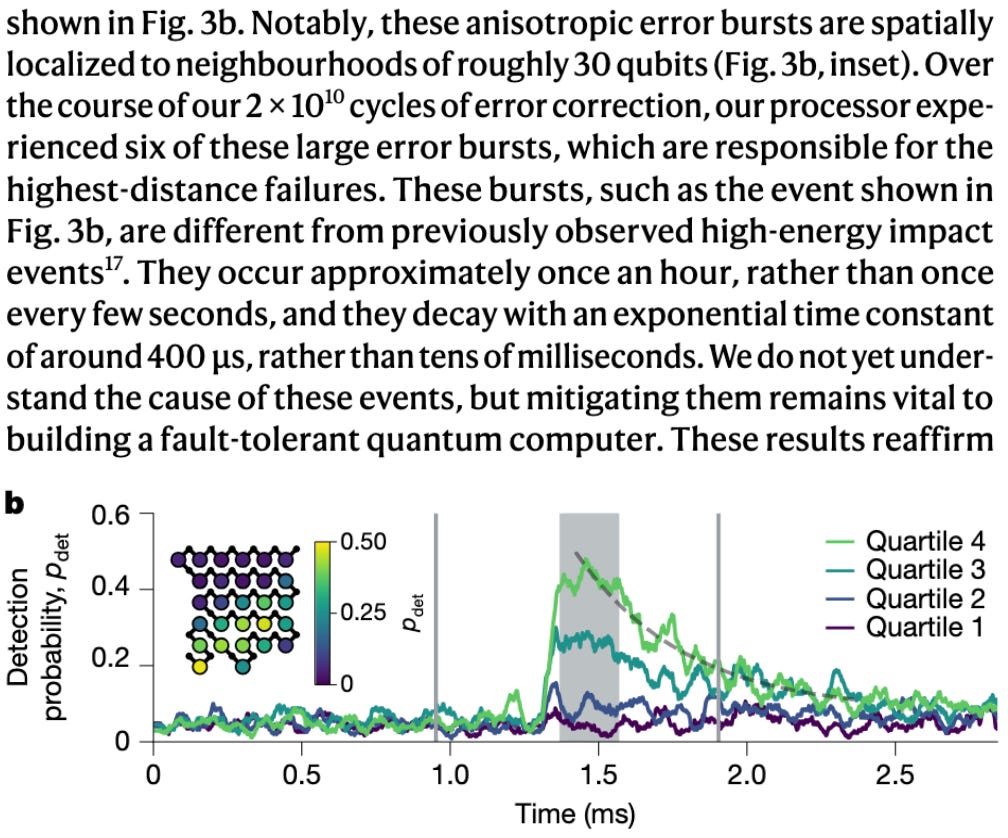
IonQ’s paper ends differently. It ends with simulations of what the proposed architecture would do, assuming the proposed hardware behaves as the proposed noise model says it will. The simulations agree with the architecture. Of course they do. Simulations always agree with the person holding the keyboard. It is their one professional obligation. A simulation that disagreed with its author would be fired on the spot. The simulation has no access to the mystery error that hits once an hour. The simulation is polite.
A laboratory is rude.

This is why experimentalists have always been the moral center of the physical sciences. Theorists write what they believe should happen. Experimentalists write what actually happens. When the two disagree, physics forces a choice, and almost always the laboratory wins. Reality, inconveniently, has opinions, and in the end reality gets the last word, usually quietly over dinner, sometimes more loudly in front of the graduate students.
The quantum computing industry is now producing a new kind of scholarship that sidesteps this part of the contract. IonQ’s full-stack architecture paper — compiler, logical layer, micro-architecture, decoder, applications — is a blueprint for a machine that does not exist. It is evaluated by its internal consistency, by the plausibility of its noise model, by the elegance of its code constructions. These are worthy criteria. They are also the criteria used to evaluate a novel. A novel about a walking cat would pass them with flying colors.
Google’s paper reports a machine that exists and confesses what the machine did wrong. IonQ’s paper reports a wish and, inevitably, confesses nothing. Blueprints do not misbehave. Only hardware misbehaves, and only a field with hardware has a mechanism for embarrassment.
Notice, by the way, that the IonQ paper has a press release that praises it as “Setting a New Standard for Technical Specificity and Transparency”. Well, what else could it have said? Simulations Agree With Architects: Simulations Confirm. Or IonQ Announces That Hypothetical Machine Would, If Built, Work. Or maybe Researchers Model Proposed Device; Proposed Device Performs Exactly As Proposed. There is nothing to celebrate, because nothing has happened yet. One can only pat the simulators on the shoulder and thank them for their continued cooperation. They have done their job, which is to say yes.
If the paper is a prospectus, the press release is a dramatization of the prospectus, and neither document has heard from the one party whose opinion would matter, which is the machine in the lab. Until the machine exists, everything published about it is, at some level, a story the theorist is telling herself, and the simulations are there to agree enthusiastically.
The Google paper has a celebratory press release because a chip did something in a room (forgetting for a moment that those unexplained error bursts didn't make the news). The IonQ paper has a kinda-woulda press release because the room is still being imagined. The footnote in the Google paper says, in effect, that they do not know what causes the error but they know it is there. The IonQ paper cannot even write the equivalent sentence. No cat has yet walked through that architecture, so the architecture has never been tripped up by one.
One of the papers cannot be wrong. It also cannot be right. It occupies the pleasant but uninhabited territory between fiction and physics, and the industry has cheerfully set up camp there. The other paper, in the end, is doing the older kind of work, no matter what it finds — even when the findings stay buried.
***
Good, we are done with architecture extrapolations for a while. Ask if you want more.
The next sequence will widen the lens. The science-and-marketing split this arc found in two papers from two companies is the working method of the NISQ era — eight years, thirty-something press releases, four hardware platforms, all of them now matched by a laptop. Five posts on The NISQ Trap.
We start Monday.
These go out twice a week. No paywall, no upsell.