
A Hamiltonian that was solved with a pencil in 1931
The NISQ Trap, or, How to Waste Eight Years on Press Releases - Part 2

The first post of this series traced the Sycamore demonstration from its 2019 announcement to its de-quantization by Pan Zhang’s group in Beijing. The moral: the hardware ran a circuit it was capable of running, and the property that let the hardware run it was the same one that let classical methods compress it.
Today’s post is about a similar pattern, on another side of the loop, with one difference. The Sycamore de-quantization took fifteen months of effort by a small group of theorists. The Heisenberg-chain de-quantization requires a graduate student with a laptop and an afternoon.
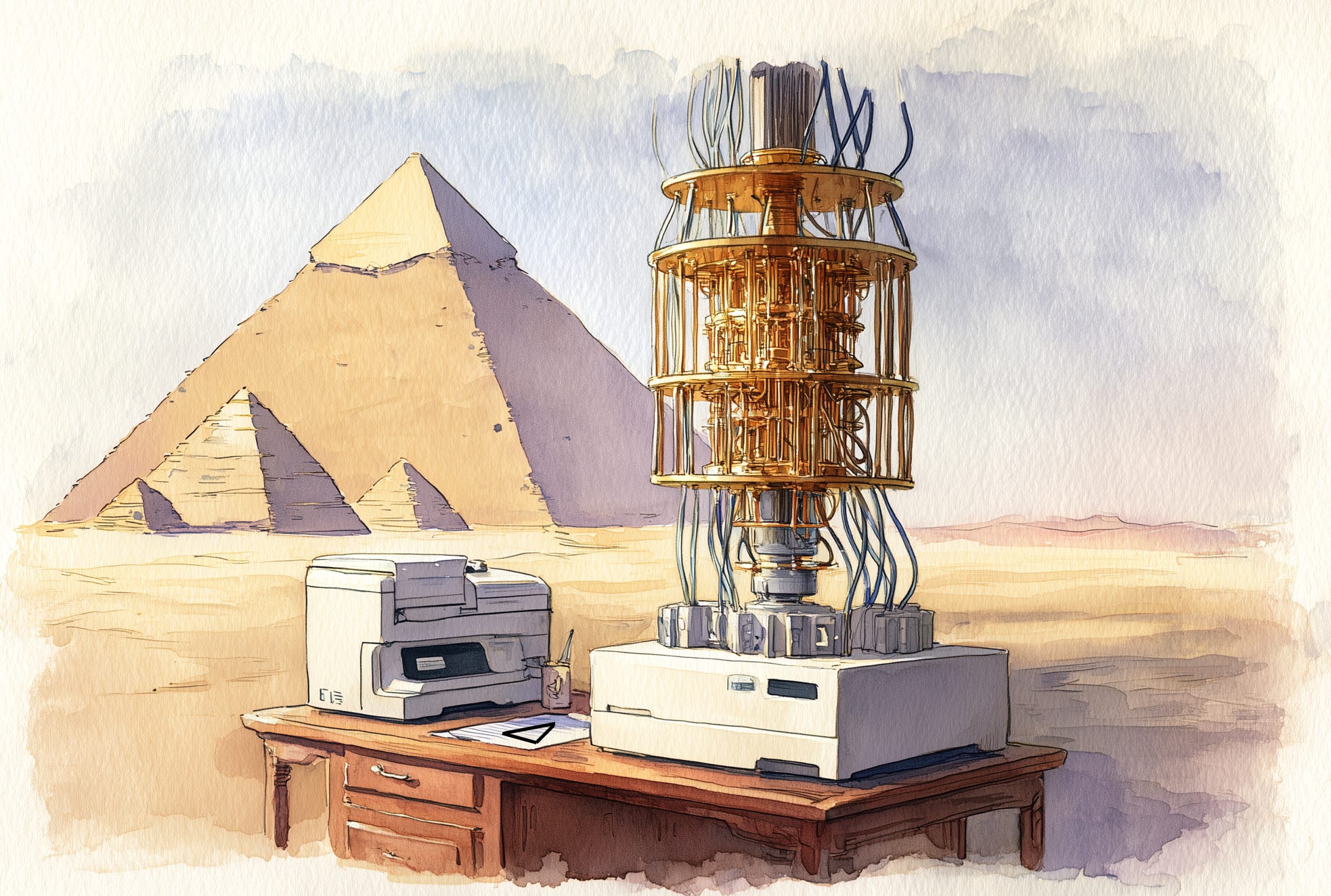
Two demonstrations. Same Hamiltonian. Both announced in 2026 by the IBM-Oak Ridge collaboration. Both ran on superconducting hardware. Both were absorbed into the press cycle as evidence of “a significant step towards using quantum computers as reliable tools for scientific discovery.”
The two demonstrations
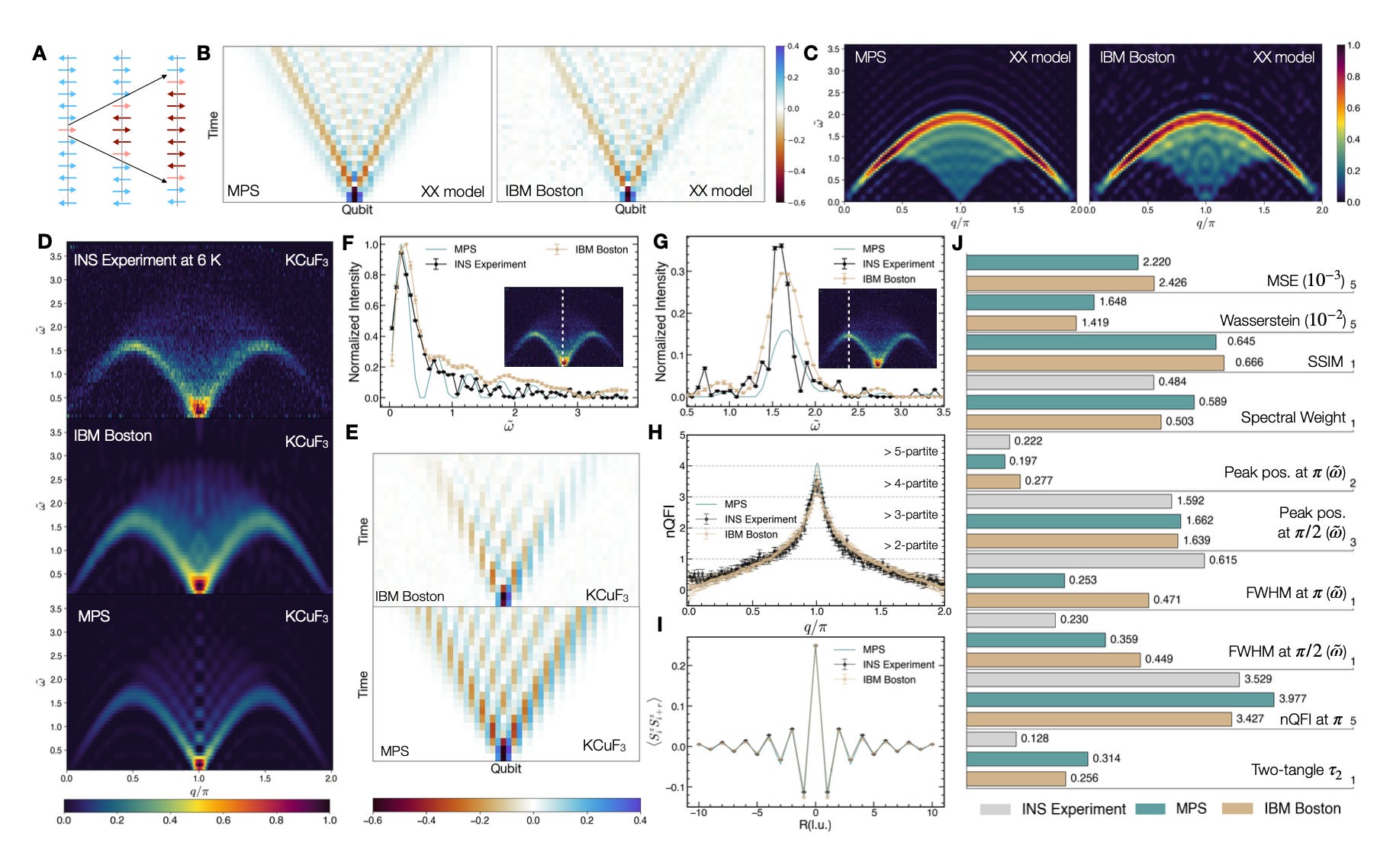
On March 26, 2026, IBM and Oak Ridge National Laboratory announced a bench-marking paper in which a 127-qubit superconducting processor simulated the magnetic dynamics of KCuF3, a real material whose copper atoms behave like spins arranged on a one-dimensional chain. The team compared the simulation against neutron-scattering data, the standard experimental probe for how disturbances propagate through such a material. The match was good. The press release framed the result as a demonstration that quantum hardware can now reproduce the dynamics of real materials.
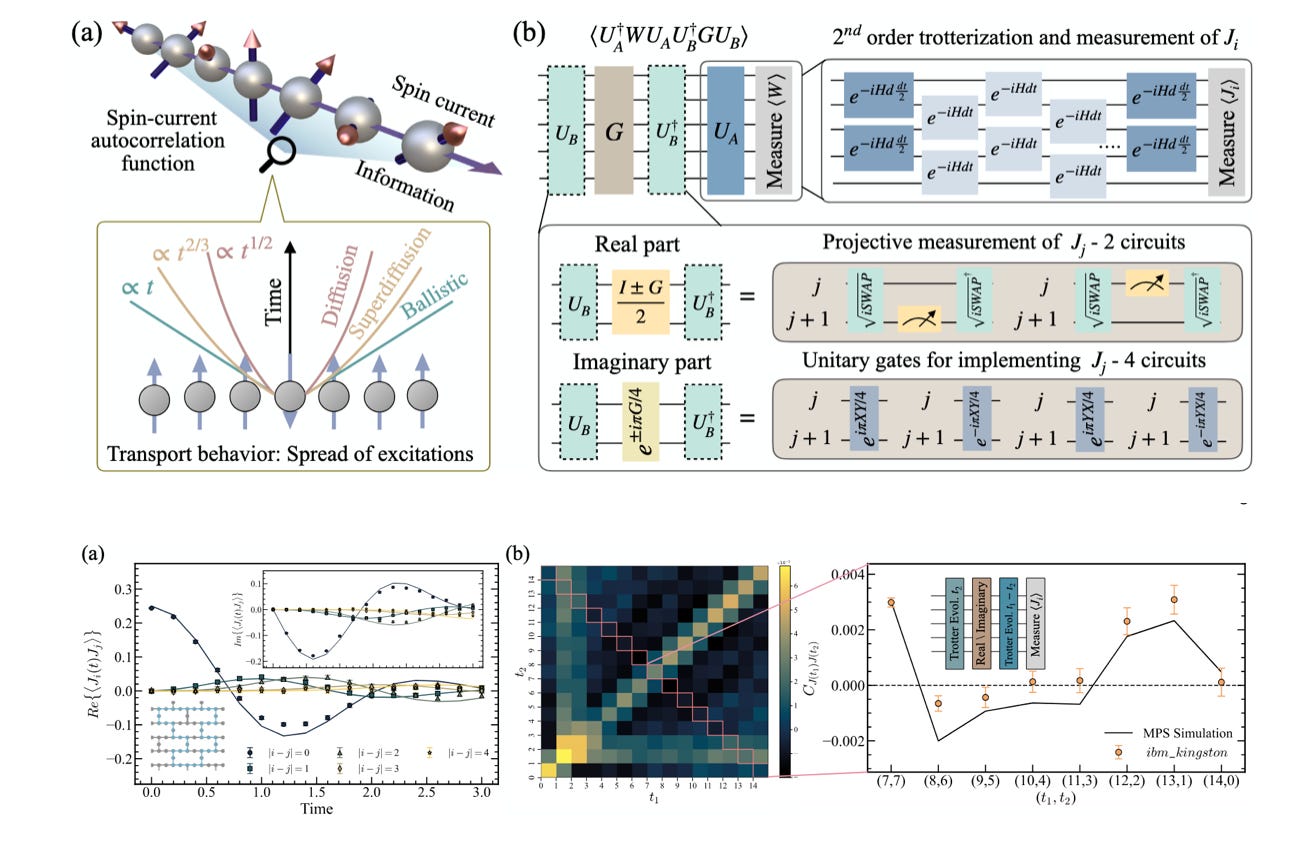
Three weeks later, on April 13, 2026, the same collaboration announced a second paper on how a localized disturbance spreads through the same kind of chain. The hardware ran circuits long enough to extract the three known transport behaviors: ballistic (the disturbance spreads at constant speed, like a runner with no obstacles), diffusive (it spreads like dye in water), and a third intermediate regime named after a 1980s surface-growth model that this kind of chain is known to exhibit. The press release framed this as evidence that quantum hardware can address dynamic problems that pose challenges for classical supercomputers.
Bethe with a pencil
The Heisenberg chain is the simplest interesting model of magnetism: a row of tiny magnets, each one nudging its immediate neighbors. The whole system is described by writing down the nudging rule for one neighbor-pair and applying it down the line. It is the simplest interacting quantum spin model that exists.
Hans Bethe wrote down the exact solution in 1931. His paper introduced what is now called the Bethe “guess”: a guessed form for the energy states of the chain, controlled by a handful of numbers that satisfy a system of equations Bethe also wrote down. The guess turned out to be exact. The method gives the energy levels, the temperature behavior, and the way one part of the chain talks to another, all to any precision required. Ninety-five years of subsequent work has extended the method, refined the analysis of the equations, and worked out how the chain responds to being poked in detail. The model is, in the technical sense, completely solved.
The transport classes the IBM/ORNL papers report were known before the experiments ran. Ballistic transport falls out as a consequence of the conservation laws Bethe’s solution exposes — quantities the chain is forbidden to lose, which keep disturbances moving cleanly. Diffusive transport, when small disturbances are added that break the model’s pristine structure, is described in standard references. The third regime in the pure chain was identified theoretically and confirmed numerically by 2019, with the precise functional form pinned down both by laptop simulations and by neutron-scattering experiments on KCuF3, the material itself, in the same year.
The 2026 quantum demonstrations reproduce a magnetic-response curve and three transport classes that have been textbook material for a decade or more.
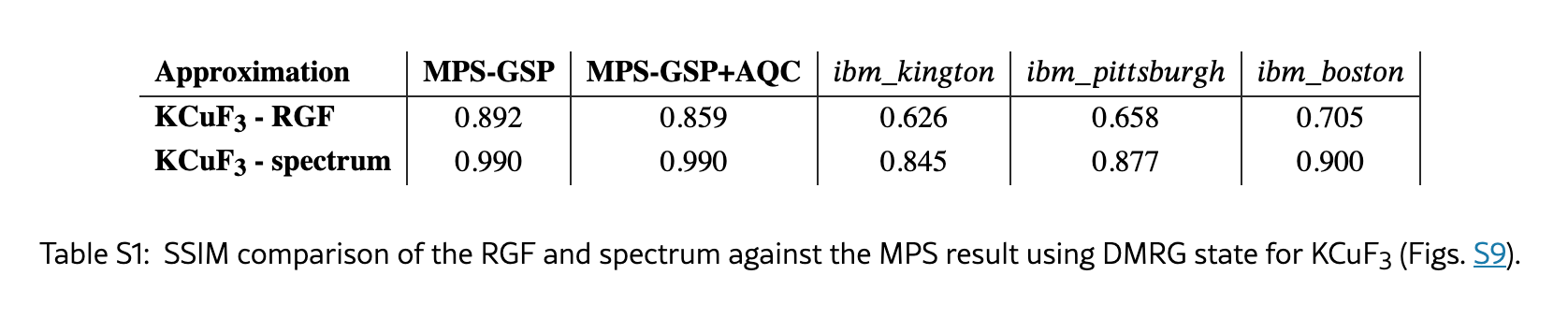
The numbers in the IBM/ORNL paper say so directly. To add insult to injury, note this: Table S1 of the supplementary material reports the classical simulation scoring 0.990 against the reference neutron-scattering spectrum. The best quantum run scored 0.900. On the paper’s own similarity metric, classical beat quantum by nine points! The paper also notes that where the quantum output appeared closer to experiment on certain measures, the closeness was hardware noise smearing the intensity, an artifact of the noise rather than a physical match. The press release mentions none of this.
What the laptop can do
Matrix product states are a compact way of writing down quantum wavefunctions for one-dimensional systems. The compression works because of a fact about one-dimensional quantum systems: in their low-energy states, the entanglement that knits the system together is mostly local. Cut the chain in two and only the spins near the cut are quantum-mechanically tangled across it; the rest do not care, like cousins after the will was read. So the description of the whole chain fits inside a structure that grows modestly with length rather than blowing up exponentially. The standard algorithm using this compression, the density matrix renormalization group (DMRG), introduced by Steven White in 1992, has been the workhorse for one-dimensional quantum dynamics for over thirty years.
A modern MPS code running on a laptop reproduces the KCuF3 data in roughly an afternoon of compute time. The transport calculations in the second IBM/ORNL paper are accessible to the same code on the same laptop, in the time it takes to drink a cup of coffee for the first two transport regimes, and in a few hours for the third.
The IBM/ORNL hardware ran the same model on 127 qubits. The hardware required short circuits, chosen to keep the noise from washing out the signal. Short circuits keep the entanglement low. Low entanglement is exactly the regime MPS handles efficiently (and as the table shows, even more accurately than the QPU does). The hardware constraint and the laptop’s reach coincided.
What the press release said
The IBM and Oak Ridge press releases’ framing of this admirably hard work as evidence that quantum computers can address problems that pose challenges for classical supercomputers is a red herring. As we just saw, a laptop suffices. The framing also gestures toward materials discovery as the long-term application.
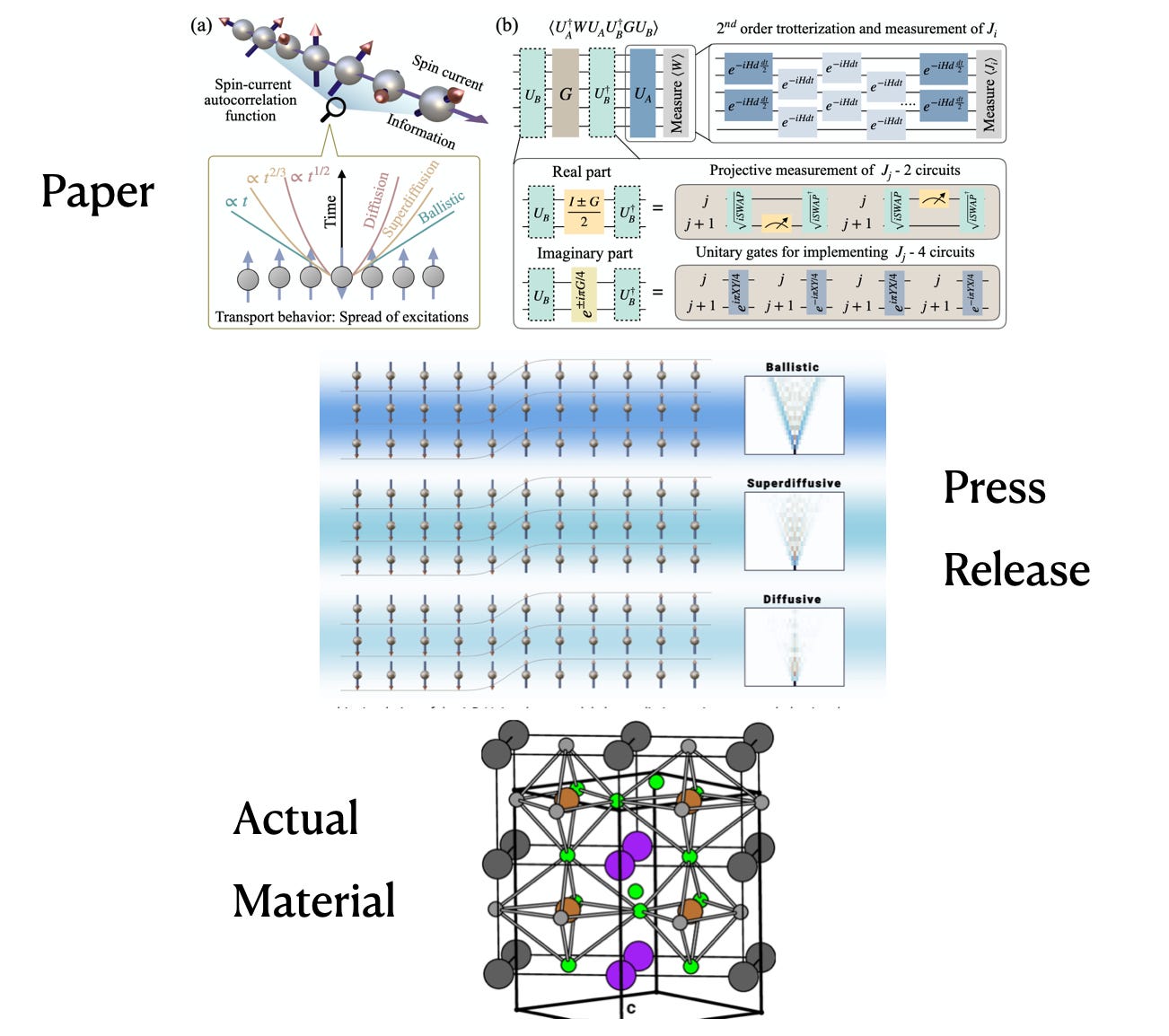
Materials discovery is a two- and three-dimensional problem. The genuinely complex cases for classical simulation, two-dimensional frustrated magnets, electrons hopping on a square lattice, three-dimensional metals, are precisely the cases where the laptop trick stops working, because the entanglement of those systems is no longer mostly local in the right way. The quantum demonstrations were two dimensions short of the application as advertised.
The reason the ORNL scientists kept the demo one-dimensional is that the current quantum hardware cannot run anything else. Two-dimensional simulation requires either longer circuits than the noise allows, or a chip with the qubits wired up in patterns the planar superconducting layout does not provide cheaply, or both. The quantum hardware was capable of one-dimensional Heisenberg simulation. One-dimensional Heisenberg simulation is what classical methods do best. ORNL didn’t have a choice. That’s what NISQ-era hardware can deliver.
The pattern
The first post described how the Sycamore demonstration ran a random circuit whose structure put it within reach of tensor networks. This post describes how the IBM/ORNL demonstrations ran a model whose structure put it within reach of matrix product states. The two cases sit on different sides of the loop, but the loop is the same.
I already acknowledged the rebuttal a defender of NISQ might give (“yes, but the QPU is more efficient energy-wise”) and I answered it (“that wasn’t how quantum advantage was framed.”) The same answer applies here, with one extension that can preempt senior figures in the field who are reaching for it when pressed: that engineering takes time, that Rome was not built in a day, that the NISQ-era demonstrations are steps along the long and winding road to fault-tolerant hardware that will eventually be useful. The first half of this defense has merit. Coherence times and Fidelities have improved. Error correction is starting to work. None of that is in dispute. The second half does not follow.
Rome was indeed not built in a day, but the Romans didn’t constantly announce the Colosseum while they were still hiring the architects. The engineering trajectory does not require quantum-advantage press releases on Tuesday, every Tuesday, to proceed. The papers behind the press releases are technically careful, and the engineering progress they report would be valuable as diagnostic engineering progress. The advantage claims are a separate genre, written by communications departments, attached to engineering papers to justify continued funding. The hardware engineers, in their own voice, say five to ten years, perhaps, with fault tolerance, if many unknown factors align. The press rooms have not waited. They have produced thirty announcements of advantage already.
I said this in Post 1 and I will repeat it here: The pattern this quintet describes is an empirical observation. A future demonstration could exploit a feature the simulability theorems do not yet cover. After eight years in which every flagship has been reproduced classically within months, the burden of producing such a demonstration sits with the defenders of NISQ.
The next post is about a result that closes off the third side of the loop: a 2024 theorem proving that variational quantum algorithms (VQA), the entire NISQ-era hybrid corpus, can be matched by a laptop on every machine the field has built.